

What Your Money Beliefs Are Costing You
Meridian: Small Business, Big Impact Podcast, Season 3, Episode 1: The Entrepreneurial Mindset
Running time: 29:41. Host Jay-Ann Gilfoy and guest Rhiannon Rosalind sit facing each other in grey armchairs in a bright white studio set styled like a living room. Behind them are white shelves holding white vases and a framed painting. Jay-Ann wears a white suit with a green patterned blouse. Rhiannon wears a white blazer and top with a lavender pleated skirt. The video cuts between close-ups of each speaker and a wide shot of both. Visual descriptions appear in square brackets. Each speaker turn begins with a timestamp.
0:00 [The Meridian “M” logo appears on a light blue background, with wave lines under the smile.]
0:03 [Text on light blue: “A Meridian Podcast.”]
0:05 [Jay-Ann Gilfoy sits alone in an armchair, smiling. A caption appears: “Jay-Ann Gilfoy, CEO, Meridian Credit Union.”]
0:04 JAY-ANN GILFOY: Hello and welcome to Small Business, Big Impact. I’m your host, Jay-Ann Gilfoy, CEO of Meridian Credit Union. Today we’re getting into how you should approach business.
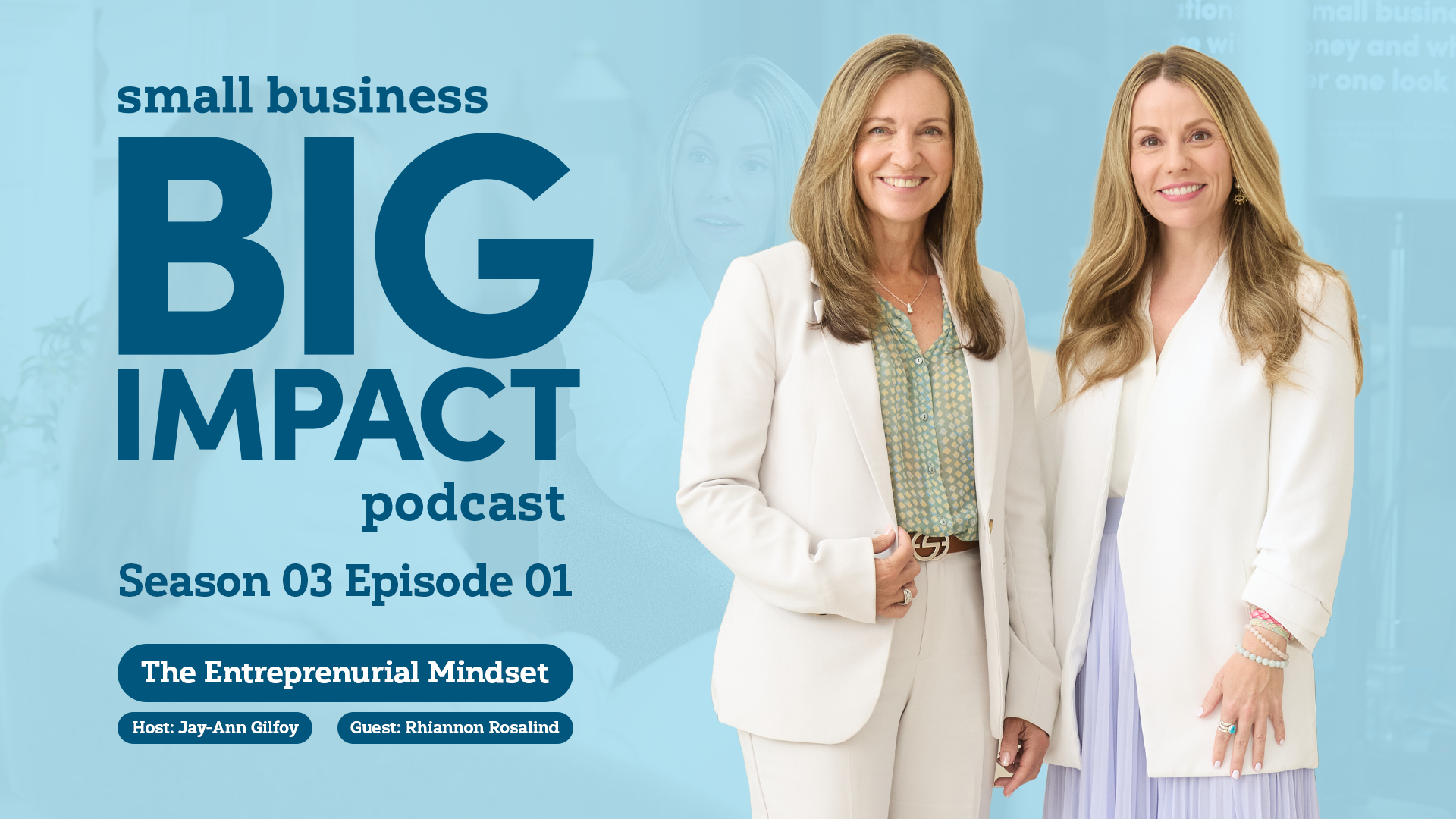
0:16 [Episode title card on light blue: “small business BIG IMPACT podcast. Season 03 Episode 01. The Entrepreneurial Mindset. Host: Jay-Ann Gilfoy. Guest: Rhiannon Rosalind.” Beside the text is a photo of both women standing side by side in white outfits.]
JAY-ANN GILFOY: And no, we’re not talking about tactics and tools. We’re talking about the things underneath all of it, your mindset as a business owner and how deeply it shapes everything from the decisions you make to the way you handle everyday challenges.
0:35 [Close-up of Rhiannon. A caption appears: “Rhiannon Rosalind, CEO & Founder, Conscious Economics.”]
JAY-ANN GILFOY: My guest today is Rhiannon Rosalind, a social impact entrepreneur, CEO, and founder of Conscious Economics, who has had a passion for entrepreneurship since the age of 10. Rhiannon brings both lived experiences and on the ground research to the question of what it takes to thrive as a founder. Thanks Rhiannon for joining me today. Before we dive into today’s conversation, we asked one of our small business members to help us get started with a question. So let’s take a look.
1:04 [A light blue Meridian wipe transitions to a new location. A man in a green striped polo shirt speaks to someone just off-camera in front of a warm beige wall. A caption appears: “Dr. Kevin Kelenic, Owner, Fonthill Chiropractic Clinic.”]
1:04 DR. KEVIN KELENIC: Hi, my name is Dr. Kevin Kelenic. I’m the owner and chiropractor at Fonthill Chiropractic Clinic in Fonthill, Ontario. My background specifically specializes in sports medicine and exercise physiology, but I help a variety of different patients with issues such as low back pain, shoulder pain, knee pain, hip pain, and have had great success in being in the Fonthill area. My question for you is, what’s one thing that you thought defined success that you see differently today?
1:33 [The video returns to the studio with a wide shot of Jay-Ann and Rhiannon. The conversation continues here with no on-screen text until the end of the episode.]
1:34 JAY-ANN GILFOY: Ooh, that’s a great question, Kevin. As I think about my early career, I think what defined success for me then was getting to that next thing. I’ll be happy when, I’ll be successful when that next thing happens. And I think, what I learned over my career was that stops you from living in the moment. So I think I’m much more thoughtful and conscious about living in the moment. And making sure everything that I’m doing every day is aligned with purpose, aligned with kind of helping others grow and creating something that’s, you know, sort of for today as well as for tomorrow. How would you answer that question?
2:15 RHIANNON ROSALIND: I think we have to go through the process of looking for the external success before we realize that that isn’t the fulfilling thing and that it’s actually this internal fulfillment that we’re searching for. And so for me, success to me now is being able to have the time to be more present. And so it’s not just about meeting that milestone in business or seeing a certain amount in my bank account. And it’s also about a slower morning. Or being able to actually spend that quality time with friends and family. And it sounds so cliche until you’ve experienced the alternative. And I’ve definitely experienced the alternative of just that chasing.
2:56 JAY-ANN GILFOY: So let’s start with a big question. Do you think entrepreneurs are born or made?
3:02 RHIANNON ROSALIND: So I think both. So we all can think of a chef who’s gone to an amazing chef school and does exquisite cuisine. But we also know what home cooks are all about. The ones that have learned special recipes that have been passed down through generations. So I think that a born entrepreneur is more like a home cook. Somebody who has been maybe experimenting in their business kitchen, so to speak. And then there are those that are going out and pursuing an academic path to entrepreneurship. So they’re going to business school, they’re studying, they know all of the terminology, they know of all the tricks, it’s a little more slick. And so for me, as a born entrepreneur and someone who works with a lot of born entrepreneurs who are moms and women and people who never thought that they would be business owners, it’s a different essence, I think, a different element, but it’s still business and you’re still an entrepreneur. And so I believe that I am a born entrepreneur.
4:02 JAY-ANN GILFOY: And I think you started your first business at 10. So looking back, what do you think was really driving you at that age? And what does that say about entrepreneurial motivation?
4:11 RHIANNON ROSALIND: So I think that’s a really important thing that you said, motivation, entrepreneurial motivation. And I do believe that that’s not a one size fits all answer. I think we’re all motivated by different things. For me, I was being raised by a single mom, and money was tight. And I remember that I wanted to belong and fit in at school, and there were kids that used to go after school and get pizza and popsicles. And I didn’t want to keep asking my mom for pocket change because I felt her stress. And so I started to think, what could I do to earn my own money? And so my best friend and I started dog walking in the neighborhood, which became Willowdale Dog Training, which we ran for five years, training dogs in the end, walking dogs. And I had my own pocket change. And so two things could be true. I could do something that I loved with my friend. I could earn my own money and I didn’t have to feel that I was adding more pressure to my mom.
5:11 JAY-ANN GILFOY: And so, obviously you were 10, so you couldn’t go out and get a job. Yes. But then when you could go out and get the job, did you decide to go out and get a job, or did you?
5:19 RHIANNON ROSALIND: As soon as I could work, I did. Okay. But I was always creating things on the side as well. So I was the type of kid that thought it was fun to door knock and sell things. I remember my grandmother making cookies, and I asked her if she could put green icing on them so I could go and door knock, and talk to people about climate. Oh, wow. And called them climate cookies. Really? And it was just part of my nature. So I think that for me, business has really been about relationships and people. And being able to engage. And it’s almost like you’re selling your essence, you know? You get to go out and engage and talk to people about something that you’re passionate about.
5:58 JAY-ANN GILFOY: I love that. I think business is about relationships and people. And I think as we get into this world of AI and things that we’re all learning how to do differently, I still think those are the things that will differentiate success.
6:12 RHIANNON ROSALIND: I believe that and I think that that takes work and that takes awareness of keeping our humanity intact while also using the tools and the technology.
6:23 JAY-ANN GILFOY: So you work in the space of financial well-being and money psychology. What’s the most common unhealthy relationship a small business owner has with money and what does a healthier one look like?
6:35 RHIANNON ROSALIND: This is a very big question that you’re asking. It’s sort of the thesis behind all of the work that I do. And so I’m going to break it down. The first most common is that we don’t examine our money stories to begin with. So very commonly, most business owners don’t ever think about the money stories they inherited, whether that be through their upbringing, watching their family or also systemically. So if people have sensitive experiences culturally with money, those will impact you in your business and the way that you handle money within your business. Once we start to actually examine the money psychology, what are some of the most common? So one of the first ones is, I’m not good enough. And so how does that show up in business? I’m not good enough, a lot of the times it’s undercharging. So someone will come in starting a business and they’ll say, well, I’ve just started this business so the product has to be priced at here, you know, this certain threshold. When really they’ve had maybe 20 years of a career of why they’re even starting that business to begin with, and now all of a sudden they have this belief that they’re not good enough and it’s really impacting their pricing. There’s another one that is I’m not worthy. Now that sounds the same as I’m not good enough, but it’s different in how it shows up in business. I’m not worthy shows up as giving away things for free, not even charging at all. So I see a lot of the entrepreneurs that we work with at Conscious Economics who will come in and they’ll have a free session, maybe say if they’re, you know, trying to get a coaching business off the ground. And they’ll do a free session that’s supposed to be 15 minutes and they will give an hour and a half and they give away a full session because of that unworthiness belief. One that we see a lots of the time with folks that are first in family entrepreneurs, they may come from a cultural background where it was like, you need to be a doctor, You need to be a lawyer. You need to be an accountant. And so now they are going into the entrepreneurial space and they actually believe before they’ve even started that they won’t be successful. Because of that, it’s impacting the way that they’re showing up or their tolerance for the ups and downs that come with starting a business. If you have to pivot or whatever else, but if you have that belief that’s knocking at the door of your subconscious, that’s gonna impact the way that you show up.
8:50 JAY-ANN GILFOY: So that’s fascinating that like worthiness and feeling like you’re not good enough, you know, you’re the first in. And so maybe you’ve got pressure that feels like a lot of the same feelings that people have about a whole bunch of things, right? Whether it’s being an entrepreneur or progressing in a career inside an organization or so, but they’re also the opposite of probably what helps make them successful. Like there’s like, so how do you know when that line is balanced versus it’s tipping, because I would imagine though some of those things are about, oh, I’ve got to be better. I’ve gotta be worthy. So how do you find that right balance?
9:33 RHIANNON ROSALIND: Money is a reflection of the relationship that you have with yourself, and that is true with business. So it all comes back down to this human capacity piece. It’s really not to differentiate it. It’s going to show up in business if it’s showing up in other aspects of your life. So if you’re feeling that feeling of unworthiness, it’s probably showing up in your day-to-day relationships as well. And I think that is the culture that we’re in. It’s this constant striving for perfection. And especially as women, I think we have this feeling of we need to have the perfect health, have the the perfect body, even rest well. I think what it really is, is getting okay with being human. Getting okay in your skin. Realizing that if you wanna start a business, it’s going to be a process and it’s gonna unfold just like a relationship. We talk about honeymoon phase in a relationship, Honeymoon phase in a business is before we’ve gotten our feet on the ground and we’ve gotten wet and we’ve started to raise the capital and everything else. It looks like a dream. A business plan looks like a dream. Executing it is always going to bring up new things. So I really think that to have a healthy financial, financially well self-concept, it’s around getting comfortable with flexibility. It’s around realizing that just like the seasons change, so do your needs change. It’s okay to maybe take your foot off the gas a little bit on this part, or move forward on that part. And so it’s flexibility, yeah, and not getting rigid in these beliefs.
11:08 JAY-ANN GILFOY: So you work within what you call the Conscious Economy. Can you explain what that means?
11:11 RHIANNON ROSALIND: Conscious is just another word for awareness. So I really believe that the economy is a reflection of our values as a society. And I feel that so many of us are starting to feel this craving for a new value system. So for me, the Conscious Economy is around really aligning our values to the way that we do business, to the way that we work, to the way that we spend. And it’s foundational to a few pillars. So for me, it’s the well-being of people. So the well-being of people in business, the way we work, but also how we design our organizations. It’s the wellbeing of the planet. And for me that’s about actually coming back into relationship with nature as well, because it’s otherwise just words, wellbeing of planet. But what does that mean if I’m not even spending time with the seasons, with the cycles, so actually starting to align our business to something that is more natural. And then using profit as a vehicle for social change. So really being able to say, hey, making money doesn’t have to be a bad thing when we’re aligning that to actually using it as a vehicle to create the things that we need in the world. So I don’t need another, you know, sparkly shoe, but I do need to, you know, see that my children are going to be in a world that’s still going to exist. And so these are fundamental things that we can actually start to use business to solve. And that is what the Conscious Economy is all about, that deeper awareness of how we’re impacting people, planet and how we are using and driving social change their business.
12:48 JAY-ANN GILFOY: I think much very aligned with sort of where we’re, where we are as a cooperative and a Credit Union, like, you know, the idea that cooperatives are formed when people come together to solve problems for each other. And then, you know, money, to your point, without money, it’s hard to solve problem.
13:08 RHIANNON ROSALIND: I think that we’re also right now, we’ve got the younger generation that’s very frustrated with how they’re seeing certain things unfold, but they’re forgetting that money is actually a way in which to actually create the change we want to see in the world. And so there’s an anti-money or an anti business rhetoric that’s starting and we at Conscious Economics I think are really changing that. So the intergenerational conversation needs to be one where we start to look at this that way, and you guys do cool stuff on that. Yeah.
13:40 JAY-ANN GILFOY: One of the things that comes up in your work is the idea that business can act like a mirror by reflecting back on our own psychology, relationship with money, personal challenges. So what does that actually look like in real life?
13:53 RHIANNON ROSALIND: For me, again, single mom raising me, which meant that my father was not in my life. And so I did have a little abandonment wound. And in business, as I was hiring people and having employees, and sometimes people would move on or leave, and it was impacting me really deeply. I would take it really personally. And sometimes I would start to make decisions where instead of maybe letting someone go that needed to be let go because I was so attached. I was, it’s called the sunk cost fallacy, where I’ve invested so much into that relationship that I don’t wanna let it go, but actually it’s not working. And so until we start to do some of that inner work, it’s very tricky because we are making decisions emotionally, and that’s the dismal science they call economics, this idea that we’re just gonna behave in this patterned way, but really emotions drive our decision making. And so without that consciousness, without that awareness, we can be making decisions in our business that aren’t the best for our business or ourselves.
14:59 JAY-ANN GILFOY: So how do you find the time to make sure you’re reflecting? Sounds like you need quite a bit of reflection to think about some of these things, right?
15:05 RHIANNON ROSALIND: You make the time when to realize that you’re making the same mistakes over and over again. Another thing that’s very common is people get a certain threshold of success and they can’t rise above it. I had two offices across Canada, things were going really well and I wanted to open that third. And as I wanted to open that third, every time something would happen, there would be another risky decision that went wrong. And I realized that I had a threshold inside of myself of worthiness around what I could or could not do. And also that there was beliefs that had been sort of put into my subconscious in my household. And what I mean by that is in my mom and other family members being sort of blue collar workers, I always heard that wealthy people didn’t care as much. And that hardworking people were working class people. And all of a sudden I’m making this threshold where this is gonna put me into a new category. And I guess subconsciously I was afraid to not belong to my family of origin. Am I gonna be one of those people that we spoke about at the dinner table? Does me earning this amount make me one of those people that doesn’t care? The reflection and the time that it takes in order to really start to examine these things is the time it takes to become the success that you wanna be, and that is the trade-off. And if we want sustainability, these practices have to become a part of our lives.
16:37 JAY-ANN GILFOY: I love it. A lot of business owners want to run a values-based company, but worry that leading with purpose means sacrificing profit or sustainability. How would you respond to that tension?
16:48 RHIANNON ROSALIND: I think that very tension is the tension of our culture and our time right now. This idea that the short term and the quick cash or the quick fix is going to solve in the longterm and we know that that’s not working. It’s actually not even good business. But in order to do a values-based business, we are gonna have to slow down a little bit in order to speed up. And profit is absolutely a part of running a sustainable values-based business and company. So the first thing that I direct, especially a lot of younger generation entrepreneurs is to examine the relationship with money in thinking that money is the root of all evil or money is the reason why we’re in the world, you know, a world that we are. And so actually I don’t wanna make money. But at the same time, if you don’t have the resources behind your purpose-driven business, it’s not gonna be able to make the change in the world that you wanna see.
17:43 JAY-ANN GILFOY: I also wonder if there’s something about like starting small. I think when people start talking about purpose, values-based, there’s a sense of it’s gotta be everything. But I think what you just described was it doesn’t have to be everything, you can pick something that is meaningful for you that is about not just extraction or not just taking something out of the world, it’s also about potentially giving something back.
18:09 RHIANNON ROSALIND: And we have so many small tips with Meridian, which I’m so excited about. We created the Well with Money program together to help people understand how to start small. And so a couple of ways to start small. First, it’s called values based budgeting. So what you do is you actually change the category names on your budget to something that actually represents more your value. So instead of food costs, you say, you know, nourishment. Already, just that word feels different. So now if I’m thinking about nourishment and nourishment for my family is important, I’m going to think differently about maybe I want to spend a little extra there actually. That is aligned with my value. And maybe this thing of me commuting on the 407 is actually I could take the longer route and spend a little more on the nourishment of my family. The other one is a values inventory. So I can tell you right now the things that are important to me. But until you look at how I spend, we won’t know if that’s actually true, if I’m living by my value. That’s not a shameful thing. That’s a thing saying, hey, slow down a little bit. There’s a small change that we need to make here. That’s what that means.
19:21 JAY-ANN GILFOY: So when you talked about budgeting, I felt like that was a personal budgeting, but how would you apply that to small business?
19:27 RHIANNON ROSALIND: Yeah, so one of the things that I see small businesses struggle a lot with is the right talent. So they are afraid to invest in the right talents because they think, oh my gosh, I’m not going to be able to afford it. But then they keep hiring someone who’s more junior, and then they’re not happy with the result and it’s a failure to launch, so to speak. So again, reframing the topic there. So it’s support or capacity instead of just salary. And starting to think about that. Do I wanna increase the capacity of what my business can do? So starting to think about those things actually makes you feel more comfortable psychologically to spend or to invest in those places. So it’s the same thing. It can go on the personal, it can go in the business.
20:12 JAY-ANN GILFOY: And have you seen that by doing that, business owners are more willing to invest? Yes. Because we hear a lot about where the economy is right now, obviously, you know, with trade talks, are they off, they’re on, they are off, they are on. And we’re hearing just like people are stalled. They’re stalled in their ability to invest. Yeah. So is this a way for people to kind of work through that and really think more strategically about where they put their money?
20:38 RHIANNON ROSALIND: It’s such a good point that you’re bringing up because the way that the world moves impacts us as investors, as spenders. And so right now we are in this sort of stop start because that’s exactly what’s happening at the larger scale of the world. And it will impact you unless you know how to regulate your nervous systems. When you are investing for the long term, either markets will go up and down. And a good support person is gonna tell you and help you to regulate your nervous system through those ups and downs. You cannot be successful with a plan that keeps changing. So if you know that long-term you wanna scale your business to X or you wanna be able to have this many offices or locations or whatever it is, you’re going to need to have a roadmap and a plan and you’re gonna have to stick to that plan even through the ups and downs of what your nervous system will tell you. So not being reactive. The reality is that uncertainty was always there. It was there. It was always, there. That’s the only thing that we can actually rely on and guarantee is that change is gonna happen and that we can’t actually predict what tomorrow brings. And I always think that the most important part of any business is people. It really is. So this idea that technology is gonna come save the day and that can actually, you know. Cut. Cut, cut, cut. Well, then that is also saying that we don’t value the wellbeing of people, meaning good jobs, good, healthy communities. We have to be so careful right now with what is happening with technology, which is exciting, but to actually be in our alignment and in our values. So to all the small businesses that are listening to this right now, your people are your most important asset, even with the technology at hand. So investing there and in the right talent, I don’t think is ever going to be decision that’s going to be wrong. When you are in a constant state of fight or flight, which is right now where our society is at. So when you’re watching news like that, so you feel all of a sudden this nervous, anxious feeling, well, already you’re in an amygdala response in your brain, which means that your logic and reasoning is shut off. So anything you come up with during that heightened moment, whatever plan you devise, is probably not sustainable, grounded, or even practical. But in order to get to that place, we have to go into nature. We have to breathe. We have do all the things that people are like, oh, that’s woo-woo. No, it’s actually good practical business. It’s brain-body connection. And if you’re not functioning from that level, you’re running a purpose-values-driven business. That’s just talk.
23:18 JAY-ANN GILFOY: Right, Rhiannon, you’ve talked a lot about money stress and money shame and where that comes from. So what does it take to help someone move from that place to a place of confidence?
23:31 RHIANNON ROSALIND: I think this is an important piece that there’s never a one size fits all for these questions, it’s highly individual. And that’s why I think we even know like personal banking, personalized budgeting. So when you are asking yourself those questions, some people don’t even recognize that they’re holding money stress or money shame. For me growing up in my household, one of the other things that I witnessed is that my mom was in a not so great relationship. And she kept saying that she couldn’t leave because of finances, and this is really common and a very tender topic. And so for me, again, there was a lot of association, negative association with money and also negative association with asking for help around money. So that’s personal to me. When you take the money out of the equation and say, how do you help someone with their confidence and how do we help someone who feels shameful about maybe aspects of things they’ve been through, we don’t think that that’s an easy, quick fix. We think that’s gonna require some deep reflection. We think of that’ll usually require some supports. And so this is exactly what I’m saying. It’ll require you to A, have the willingness to wanna look under the hood. Number two, to surround yourself with somebody who’s gonna be a practical, supportive advisor, somebody who can help you, both on the financial side, but also on the therapeutic side. And that’s what we do at Conscious Economics. We have an in-house financial therapist. It’s a real thing, financial therapy, and being able to actually uncover where the connection point is between some of the things that have happened to you throughout the course of your life. And how they’re impacting your relationship and confidence with money.
25:20 JAY-ANN GILFOY: That’s amazing that you put those two things together. It’s really, really powerful. So resilience, you’ve talked about a lot about, I’ve been listening to you. You’ve talked a lot, a lot of about resilience. And so from your experience, what does building resilience actually look like on a day to day while running a business?
25:37 RHIANNON ROSALIND: Yeah. So some of us come into business and we have already a strong, resilient base because life has thrown us many obstacles and that’s the born entrepreneur. But for those that maybe haven’t, we have to build that tolerance. And so that is exactly where I say what your business plan looks like on paper on day one and where you end up are usually two different things, and that’s not a failure. Business is actually about flexibility, it’s about pivoting, it’s about coming up to a challenge, and instead of like running the other way, saying, wow, how do I meet this challenge? And getting excited about it. And that’s why you need to not only invest in the right supports around how do I manage my money, but how do I also manage my mindset so that I don’t walk away from something that’s actually just getting started.
26:29 JAY-ANN GILFOY: Just getting started. Just before it starts to take off. That’s great advice. So if a small business owner leaves this conversation with one shift in how they think about themselves and their business, what would you ideally want that to be?
26:42 RHIANNON ROSALIND: Your business is a reflection of the relationship that you have with yourself. And so to take the time to pause and start asking yourself some of those deeper questions, we have an amazing program, Well with Money that we’ve done with you at Meridian. It’s a great starting place. It’s right on the Meridian website. And there are prompts and tools that can be used so you can start that journey today, which is so exciting. You don’t need to spend a lot of money. You don’t need to go anywhere outside of your house to start asking yourself new questions. And new questions lead to new answers, which lead to behavior. And it’s simple, that’s the starting.
27:24 JAY-ANN GILFOY: I love it. You and I are two women in leadership roles, you as an entrepreneur, me as CEO. So what would kind of advice would you give to women? And you’ve talked about those people who maybe come from different cultural backgrounds.
27:38 RHIANNON ROSALIND: So I think so many of us count ourselves out of being a business owner. So we either think it’s not possible for me, I’m not one of those types, and I just want to encourage, especially women that are watching this right now, especially if you’ve come from a background or a culture where it’s been taboo to think about starting your own business, that starting your business can be one of the most fulfilling things that you do with your life, because you’re getting to invest into something that you believe in and one of the really interesting [00:28:08]tidpoints [0.0s] is most successful businesses for women start after 40, so you’re not too late. I do a lot of work with women who are exiting corporate career and actually starting into the entrepreneurial journey. So again, this feeling of we’re starting at base zero is not true. Usually you have so much you’re bringing to the table, your life experiences, the ways in which you’ve formed your own resilience. These things matter in business more so than, you know, having a business degree and you can learn the things that you don’t know. And there’s so many amazing organizations and you know, supports for you. So if you have that dream, don’t hesitate because you think or you’re counting yourself out.
28:51 JAY-ANN GILFOY: So we’ve learned a lot about you and your organization today. So how can our listeners find you?
28:58 RHIANNON ROSALIND: Consciouseconomics.ca is the easiest place to find us. And then also with our collaboration with Meridian, our program’s called Well with Money. So it’s on the Meridian website and you can go right there if you’re interested in starting this journey of learning a little bit more about yourself and how your own nervous system and wellbeing is impacting your relationship with money.
29:17 JAY-ANN GILFOY: Thanks Rhiannon for joining us today on the show.
29:20 RHIANNON ROSALIND: Thank you so much for having me. I honestly enjoyed it and I think we have so much more fun in store.
29:28 JAY-ANN GILFOY: And thank you for listening. Join us on this journey by subscribing to the show on Apple, Spotify, or wherever you listen. Thanks for listening.
29:36 [The Meridian logo appears on a light blue background.]
29:39 [Text: “A Meridian Podcast.” The video ends at 29:41.]
When growth stalls, the real work often starts within. In this episode, Jay-Ann Gilfoy sits down with Rhiannon Rosalind to explore how money stories shape pricing, hiring, and business performance.