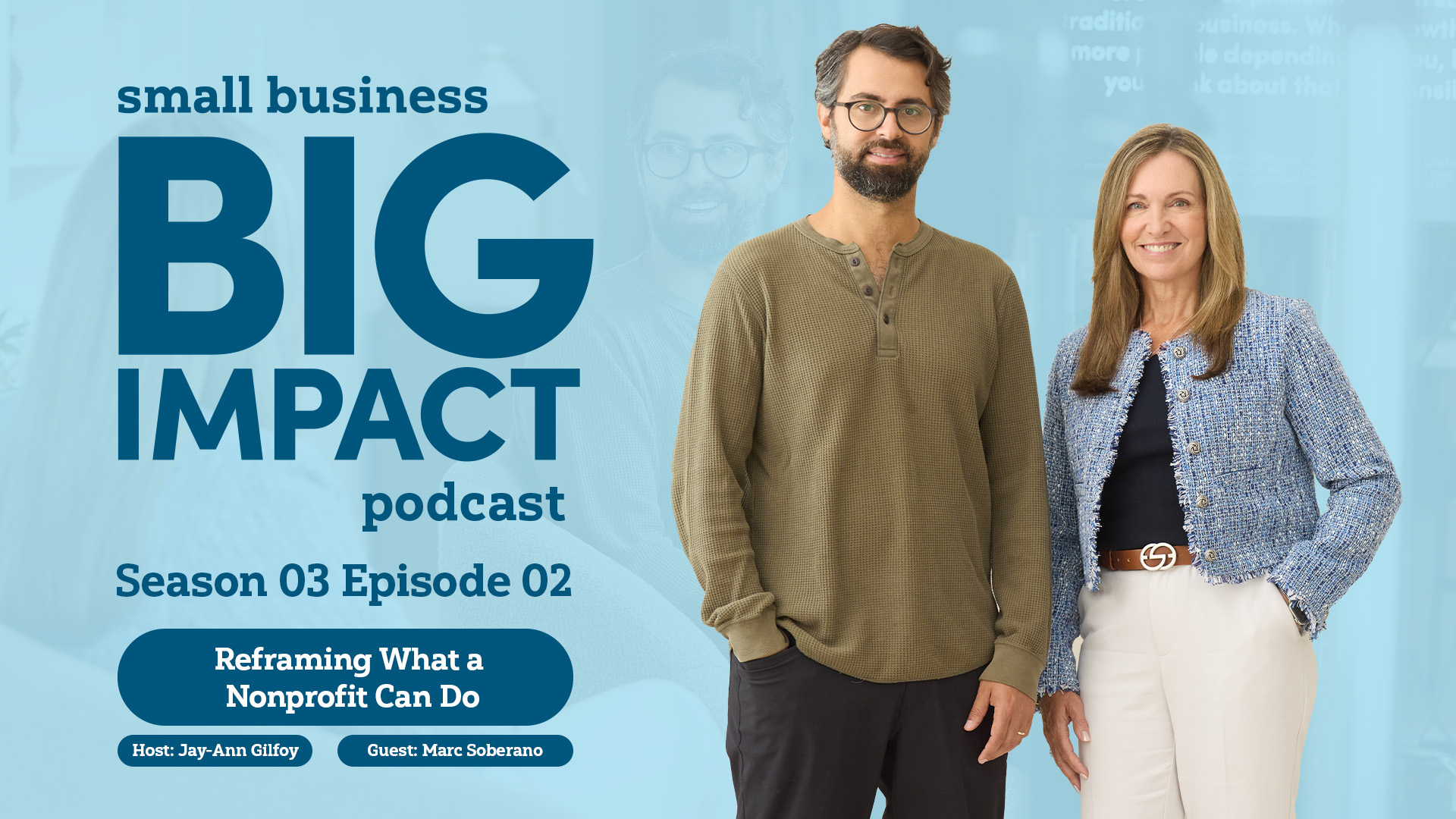

Reframing What a Nonprofit Can Do
[00:00:04] Jay-Ann Gilfoy Hello, and welcome to Small Business Big Impact. I'm your host, Jay-Ann Gilfoy, CEO of Meridian Credit Union. Every once in a while, you hear about a business that makes you think, why hasn't somebody done this before? Today's guest built exactly that kind of organization. Marc Soberano is the founder of Building Up, a Toronto-based social enterprise that trains people who face barriers to employment to work in the skilled trades and then puts those skills to work making affordable housing more sustainable. He started at 23 with no trades experience, no track record, and what he would describe as a pretty useful amount of ignorance about what he was getting himself into. Today, we're talking about the non-profit business model, what it actually means, and why it might be the right structure for more entrepreneurs than realize it. And what it takes to build a purpose-driven business that holds up over time. Welcome to the podcast, Marc.
[00:01:09] Marc Soberano Thanks for having me.
[00:01:10] Jay-Ann Gilfoy Before we dive in to today's conversation, we asked one of our small business members to help us get started with a question. So let's take a look.
[00:01:20] Deirdre McGahern Hi, Jay-Ann and Marc. My name is Deirdre McGahern, and I'm the founder of Straworks, a sustainable construction company based in Peterborough. For more than 20 years, we've been working on climate change, one building at a time. Building something that challenges conventional thinking isn't always easy, and I know every entrepreneur faces moments where they question the path that they're on. My question for you is what's the one belief that's helped you through the toughest moments of building something meaningful. Thanks, and I'm looking forward to hearing your thoughts.
[00:01:55] Jay-Ann Gilfoy I think it's the notion of momentum. The notion of like, you just need to take one step in front of the other. Like I think that's what it is, right? That progress is more important than perfection. So in times where it's either I've had personal issue or I've a business issue, it's trying to make sure I'm thinking through momentum. How about you, Marc?
[00:02:19] Marc Soberano Honestly, the same sort of thing, like for me, I remember when I was trying to get building up going, there were so many things that I didn't even know I needed to do, like set up a WSIB and all these pieces and it felt overwhelming and stressful, and it was just, like, all right, I just gotta get one step further today.
[00:02:38] Jay-Ann Gilfoy So, let's start by talking about your business, building up. It sits at the intersection of construction, workforce development, and community impact. So maybe talk a bit about how you have set that up and who it serves.
[00:02:52] Marc Soberano I studied business, and I wasn't really finding myself being like particularly drawn to the typical roles that were coming out of that, like consulting and investment banking or whatever it is that people were going to do. And then I learned about social enterprise, actually in business school and I thought like, wow, that is a really cool idea. And it was just, okay, rather than running a business to make money. You are running a business to do something positive. And it still needs to make money so that you can do that positive thing. It just really resonated with me. And as I learned more about different organizations doing that, I was just like feeling myself drawn to that. So, you know, what we do is renovations. We're a nonprofit contracting company, but where, like, where most people train and employ people to run their business, we run the business to train and employ people. So we get different projects, a lot of affordable housing renovations, energy upgrades, building new housing and use that as a vehicle to support people living in housing to get, to get work and get experience and to join the sector that needs people. So using this business as a launch pad for people and, and, you know, it could be any service. When building up started, all I was doing was selling toilets, like, I became a toilet salesman, but really the goal of it wasn't to actually sell toilets. It was to have something for people to do and learn under a plumber and learn how to do work. So we run a business to be able to have an engine to support people and help people kind of get where they're at, from where they are at, to where they want to go.
[00:04:37] Jay-Ann Gilfoy So building up a structure as a nonprofit, which is something a lot of entrepreneurs would have questions about, but they probably don't understand. Can you explain how that actually, what that means?
[00:04:48] Marc Soberano So a nonprofit doesn't mean that you don't sell services and you need to sell them for more than it costs you. What it really means is that there's no equity in the business. So like I can't go on Dragon's Den and sell 50 percent of my thing for whatever because I don't own it, and it's not my thing to sell. I'm an employee of it. I have a salary that's decided by a board and my job isn't to own the business, my job is to lead the business, and really, like, at the end of the day, everything else is pretty much the same. You know, I have this good intention of running this organization, but I also know that, like if building up a for-profit business and all the profits it generated went to me personally, I would make different decisions. It just, it's hard to remove yourself fully. Let's say we have a job that there's like a huge margin in it that's kind of appeared. Well, rather than us bringing in all that more money, we'll be able to now send more people to go learn on it. And because my personal compensation is not connected to the profit of the business, I can actually make the decision that's like, what is best for what the mission of this organization is, right? It just kind of, for me, I find it like a bit of a decision-making guide. Just the inherent greed that exists in all of us to just like take that out of it a bit and to just serve the point of the work.
[00:06:13] Jay-Ann Gilfoy So you're the founder and then did you create a board of directors?
[00:06:18] Marc Soberano Yeah.
[00:06:18] Jay-Ann Gilfoy Yeah. Okay. So then that's something that lots of entrepreneurs have to think through, right?
[00:06:23] Marc Soberano Yeah.
[00:06:23] Jay-Ann Gilfoy So how did you go about that process?
[00:06:25] Marc Soberano It felt like the first whole bunch of years of building up was just like a series of finding people that were willing to be helpful, and then just like realizing, letting the organization sort of tell me what help we needed and having conversations with people that had a very specific skillset. That was something that we needed that I had no idea how to do. And you know, I did find that like as a young person starting this thing with like a good mission and a good intention, there were, I was always surprised with how many people would meet with me and talk about it. Like, I think people want to be a part of something like this. They just don't always have, like, access to it. And if you ask people to meet, they typically wanted to meet. If you ask them to be on the board, I would always think that I'm like asking for this huge favor. And then they would say, oh my God, that's an honor. I was, like, really, it's an honor? And they said, yeah, sweet, let's do it. Finding people that you trust, that trust you, is really big, too. Because the board, ideally, isn't something that you're feeling like you are in service of and more of something that is serving the work that you're trying to do and that they trust you to push it and you can go to them for those big pieces of advice.
[00:07:49] Jay-Ann Gilfoy So I heard you say like, I look for people who had skills I was interested in. I went out and canvassed all kinds of people that I thought would be great. And then their job is to think about the, together you think about the long-term sustainability of the business.
[00:08:05] Marc Soberano Yeah, and typically the relationship didn't start with like, hey, would you want to be on the board? We had already built something where we were working together, and said, hey, do you want to take this extra step and dive a little deeper and be a part of this?
[00:08:19] Jay-Ann Gilfoy So how did you figure out this model of not, being a construction company, but being one in service of people? Like how did, and how do you make that work?
[00:08:31] Marc Soberano So what happened was Manitoba Housing, the public housing provider out there was about to insulate a couple thousand basements. It's very cold in Winnipeg and they wanted to keep the warm air. They were pumping into the building to stay there. So they were about to invest a couple million bucks or whatever in insulation. And then some people got together and said, hey, these buildings are full of people that are looking for opportunities, we're trying to stop this warm air from leaking out of the building. What about the opportunities and the income from leaking outta the building? So they got together and said, okay, how do we train and employ people living in these buildings to do the work? And then Manitoba Housing told them you have to be a contractor. And they said, how did you become a contractor? I guess you just say you're a contractor, so they did that, and they started doing it. And they got the work, and then slowly built around that, not just like a company, but a whole system of supports for people and a curriculum and a team of people that can respond to different challenges. And I learned what they were doing. And I ended up through a whole weird set of circumstances, meeting the person who got that going and said, Hey, like, do you think this would work in Toronto? He said, yeah, of course. And then before I knew it, I was staying at his house for a couple weeks, kind of following around, figuring out how it worked with the intention of bringing it back here. So it was really helpful to sort of see the vision of what it could look like five, six years down the road, somewhere else. And then it made that job easier.
[00:10:03] Jay-Ann Gilfoy So Marc, you launched Building Up at 23 without a background in trades, as you've said, based on a model you'd seen working in Winnipeg. A lot of people would have waited until they felt more ready. What made you just go for it when you did?
[00:10:18] Marc Soberano I had this like, thought one time when I was on a canoe trip, thinking about picturing a city that has, like, just lined up of stores and stores of stores, like, okay, well, someone runs all these businesses. How hard can it be? Right. So I figured it's fine. I should just go for it. Turned out to be quite complicated and hard and stressful at times, but sometimes knowing less is actually helpful. And, you know, if you know about all the reasons not to do something, that's like, you're probably not going to do it. Whereas when you, when you don't have that experience to know that you can just kind of go for it and deal with it thing by thing and not overthink it. I learned a lot more doing this than I would have learned if I just worked for someone else for a bit. You're never really ready to do that until you do it, so for me it worked.
[00:11:15] Jay-Ann Gilfoy And would you say what you do now is the same as what they do, or is it slightly different from what they used to do?
[00:11:22] Marc Soberano Same underlying principles, but really different too. Like it's kind of adapted to this different cities that we're in and the different opportunities to present themselves. At the beginning, it was like, what is the service you're selling out there and can we do that here? And now we've completely evolved and offered all sorts of different services that kind of represent what the demand is for work out there, just developed in our own way here.
[00:11:48] Jay-Ann Gilfoy We're proud to be partners with you building up through our Reframe program, which you know a lot about, which is working to tackle labor shortage, giving people facing barriers a path into the trades. We got to announce a relationship, heard some great stories. So from your side of the partnership, what does that mean for someone coming into the program? So, you know, one of the things we found out was that a barrier was financial abilities, capabilities, right? So Maybe talk a bit about what you see helpful.
[00:12:22] Marc Soberano Yeah, like I think a huge part of being successful in the trades is managing money. So it's an industry where you get paid quite a bit hourly and then you're dealing with ebbs and flows of work. Every job that you do, you're working yourself out of that job because you're getting closer to the end. And then the next one has to begin. So we found that a lot of people are coming to us with lots of different financial barriers beyond just like poverty. You know, so it might be okay. You need a license to get a job in the trade, but I've got like outstanding loans and fines on my license that I can't get a vehicle until I pay them off, but I can pay them up till I get a jobs and helping people map out what their current financial situation is, what their goals are, and build a budget and a plan to be able to achieve those. And build that confidence and literacy so that they can actually be successful. It's actually lesson of getting to the start of your career faster and more about staying there longer.
[00:13:34] Jay-Ann Gilfoy Sustainability.
[00:13:35] Marc Soberano And seeing that grow and adjusting to this change in your life.
[00:13:41] Jay-Ann Gilfoy I get the pleasure of talking to entrepreneurs like you who, you know, it's so embedded in you, purpose and profit, right? And community impact is in your business model that's probably in your DNA. So if I'm a small business owner and I want to do more of that, and I haven't thought about, I'm not set up as an offer problem. Like, what's a first, kind of, first step, as we talked about, what's the first step that somebody can think about?
[00:14:10] Marc Soberano A massive like sort of low-hanging fruit is just like as you run a business, you're employing people. So then like any decision you make with money, it's like, how can I be more intentional about that? You know, do I have a room here to give someone an opportunity that really needs it? Do my existing staff feel like I'm really supporting them? You know, and just trying to use that sort of superpower that has been developed of like being able to support someone's life to to be more beneficial, and that would be like a small incremental step that anyone could take within any structure of a business just like using the opportunity to employ people more positively.
[00:14:55] Jay-Ann Gilfoy Can you talk a bit about how you scaled your business as you started it?
[00:14:59] Marc Soberano So when it started, all we were doing was going to buildings and changing all their toilets to new ones that used less water and save them money. At that time, it was myself and a plumber and then a group of our participants. For our business, there's a couple of different pieces. There's our customers. So we would go to them and say, okay, what other services do you need? And they say, oh, well, you know, when someone moves out of an apartment, we need to refurbish it and paint it and do the flooring and okay. Maybe we could do that. And then, oh, now we've built these skills of turning over an apartment. Oh, someone, a nonprofit just got a new house that they're going to operate. It says, I mean, we could renovate the whole house. Oh, now they need a kind of tiny home in the backyard. I guess maybe we could build that slowly pushing the envelope of the type of work we can do and bringing in the right people to lead that at the same time because of our unique business. Like, as we work with more and more people, you see more and more of the challenges that people are facing and then trying to solve those problems, like the personal life. So, you know, we didn't use to have a financial coach. And then we realized, okay, like people keep on hitting this wall. We need that. A really cool feeling for me is I'll walk in to the cohort being trained and I'll see like some class being delivered that they had no idea we were even teaching, right? And it's like, okay, now we've got the right people that are coming up with the right solutions, and I just get to, like, sit and watch them build a thing, you know, so that's really nice.
[00:16:40] Jay-Ann Gilfoy So there's a common assumption that choosing a non-profit or social enterprise model means accepting financial trade-offs and that you're giving something up for the business side to do something good. How would you respond to that?
[00:16:54] Marc Soberano I think there are some like long-term trade-offs of, you know, operating a nonprofit. I don't own a business that I can sell, but I do believe that building up is successful because it's a nonprofit. And actually when I went out to Winnipeg to replicate that business out there, I didn't realize they were a nonprofit at the time. And I kept asking the guy the question, why are you a nonprofit? I don't really get it. You're doing a business here. What's the deal? He kept saying, it needs to be a non-profit, just trust me. About 70 percent of our money comes from selling services, and 30 percent of it comes from grants. We have people that are supporting people pretty deeply. To do that, you can't just rely on the profits of a renovation where we're gonna be a little less profitable anyway because we're training people on the job. So our work to operate the way we do requires grants. And another thing I've learned is that like grants aren't necessarily less sustainable than sales. You know, if you have all your sales from one customer, you're not diversified with your sales. You're not necessarily stronger than if you have that come from funding. It's just about the quality of the relationships and, you know, connected to the work you're doing.
[00:18:14] Jay-Ann Gilfoy It's not that you're accepting a financial trade-off. You're just starting from a different place, I think.
[00:18:19] Marc Soberano Exactly. Yeah, the business is there to serve the mission. We don't run a business because we want to run a business, we want a run a business because that's the best way to train people.
[00:18:31] Jay-Ann Gilfoy It's fascinating because like the last one of the other people that's been on the show talked a lot about like how do you get balance in your perspectives? How do you make sure you've got time to think strategically? And if driving revenue is the only thing you're doing, you're not doing these other things. And so I make up in my mind that you get to do some of those other things because of the structure and the way you think strategically about where's the next opportunity and how do I get more people trained? And was that something that have you grown into or is that something that kind of was always there from the beginning?
[00:19:12] Marc Soberano I think that I completely had no idea what I was getting into, you know, like, I made a spreadsheet that said that this might work, and therefore I kind of launched into it having no idea right what it actually meant when it worked. The main thing is has been like learning what I'm really bad at, and so like when I started building up I was the executive director and now I'm the co-executive director. Cause like the same skills that are required to start something aren't the same skills, that are required to manage something. I realize I'm not great at like managing the business. I'm good at growing a business and leading it when working together with someone who's really good at managing operations. So we work together really well and Building Up would not have done anything like what it done. Did has done without my colleague Tara, who's the co-executive director of building up. I've learned a lot about what it actually means to run a business.
[00:20:20] Jay-Ann Gilfoy So for a small business owner who likes the idea of building something with a social mission, but isn't sure what to do, what advice would you give them before making that call?
[00:20:31] Marc Soberano If your heart's telling you to explore it, you should explore it. I think people, people get really fixated on like, you know, building their resumes and making things. Making decisions very strategically and I found that like when I'm just doing something that I feel really called to do that before you know it, you've put together a unique series of experiences that make you really different than everyone else, you know? Versus like trying to create, manufacture something. In general, it's good to just kind of launch into stuff. And if you feel yourself getting excited to go for it, you don't need to be a nonprofit to do something positive. You don't have to like throw everything else a way to do it, right? It's just like adding, adding little things into the work that you do. I was saying before, you know, maybe you can take a chance on someone that you wouldn't have taken a chance on when you're trying to make your next hire.
[00:21:32] Jay-Ann Gilfoy So we talked about like how you've grown, and your customer base has grown, and your size of your operation has grown. Is there a limited amount of scale for you?
[00:21:44] Marc Soberano Unfortunately, it seems kind of bottomless, like, the need for stuff like this feels pretty.
[00:21:50] Jay-Ann Gilfoy Bottomless.
[00:21:51] Marc Soberano Bottomless. Right now, building up is employing, like, over a hundred people every day, which isn't something that I ever expected, but I also see so many more opportunities for us to keep growing it. So there's so much work that needs to get done in the trades, right? So it's like, so long as we're being reliable and doing good work and being honest and like, it seems like workflows. I guess there is a limit, but we're not close to it.
[00:22:21] Jay-Ann Gilfoy You're not that close to it.
[00:22:22] Marc Soberano Yeah.
[00:22:24] Jay-Ann Gilfoy That's great. Yeah, I like the, I liked the interplay between employing people, doing quality work, serving a business need and a community that's really all of that together in one, and I loved how you talked about like your thought process. Like the outcome is the same as just starting a business, but your thought process to get to that outcome is very different. Yeah. Which is the beauty of.
[00:22:51] Marc Soberano It's just driven by people, like, responding to the people that are asking for some support.
[00:22:58] Jay-Ann Gilfoy So, Marc, is there anything we didn't cover today that you wanted to share with our listeners?
[00:23:04] Marc Soberano Yeah, I think I'd want our listeners to know that their purchases are powerful, and that every time they make a purchase using one contractor or another in the trades or one coffee shop or another, or even if you're catering an event, there's a way to do that in a way that supports people. And there's lot of social enterprises like building up out there that are offering services that go beyond the service and have like an underlying mission to them that support people. For people, please, you know, use your money with your hearts.
[00:23:36] Jay-Ann Gilfoy Yeah, we at Meridian, I believe, we've used your team to help us do painting and renovations of office buildings. So there's lots of opportunity and, you know, you run a business so you still have to be competitive. So I think that's really important.
[00:23:49] Marc Soberano Totally. Yeah. It's a cherry on top.
[00:23:51] Jay-Ann Gilfoy Cherry on top. So how would our listeners find you?
[00:23:55] Marc Soberano The internet. www.buildingup.ca. All the information about what we do is on there, how to get in touch and learn more about social enterprise.
[00:24:06] Jay-Ann Gilfoy Thank you so much, Marc, for coming in today and for talking about building up and all the great things that you're doing. And I love the intersection between purpose and profit and changing the world and social mission and making decisions. It was all very inspiring. And so I appreciate you being here.
[00:24:22] Marc Soberano Thanks for having me and to Meridian for all the support of this work.
[00:24:25] Jay-Ann Gilfoy And thank you for listening. Join us on this journey by subscribing to the show on Apple, Spotify, or wherever you listen. Thank you again for listening