

April 2026 Monthly Market Insights
Data and opinions as of March 31, 2026.
Geopolitics drove dispersion
March was defined by dispersion: markets did not move as one, and regional outcomes depended on energy sensitivity, currency dynamics, and how investors priced uncertainty. With the Strait of Hormuz under heavy disruption—a route that has historically carried roughly one‑fifth of global crude oil flows—investors quickly shifted focus from “risk-off sentiment” to the real‑economy impacts: energy costs, shipping bottlenecks, and policy trade‑offs. Canada held up relatively better than many peers, supported by commodity exposure, while parts of global equities struggled as energy vulnerability was exposed and volatility rose
NEI Perspectives
Geopolitical escalation reshaped the regional risk map: Disruptions and threats around key shipping routes kept energy security in focus, and the market impact showed up unevenly across regions. Bottom line: March was a reminder that geopolitical shocks tend to travel through energy prices, shipping routes, growth expectations, bond yields, equity prices, and currency moves, creating dispersion rather than a single global trade.
Canada’s commodity tilt helped cushion risk‑off moves, even as leadership rotated: Canada as an energy exporter can benefit when energy is bid, but gold producers as heavy energy users act in reverse. Gold’s pullback despite heightened headlines, underscored that safe‑haven behavior can be overwhelmed by rates and the U.S. dollar as much as geopolitics. Bottom line: Canada looked comparatively resilient at times, but commodities did not move in lockstep. Oil strength and gold weakness told different stories in the same market shock.
Markets repriced uncertainty as investors weighed higher energy costs against growth momentum: The resilience in equity performance increasingly reflects investor confidence in earnings durability, defying the unsettling headlines. Bottom line: The month was characterized by investors demanding more for risk assets, creating larger dispersion in prices. Investors are rewarding high earnings quality and growth sustainability.
- NEI Asset Allocation Team
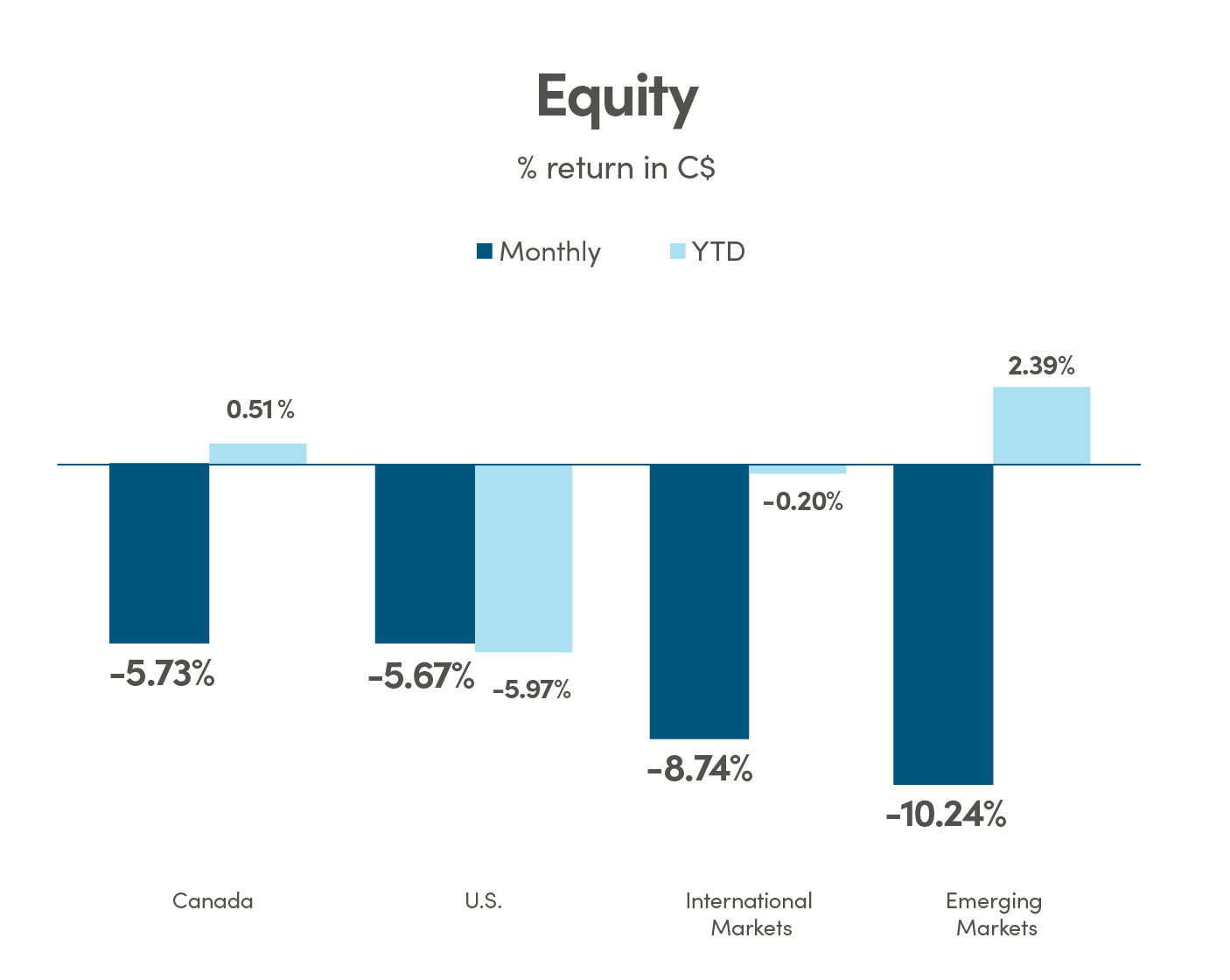
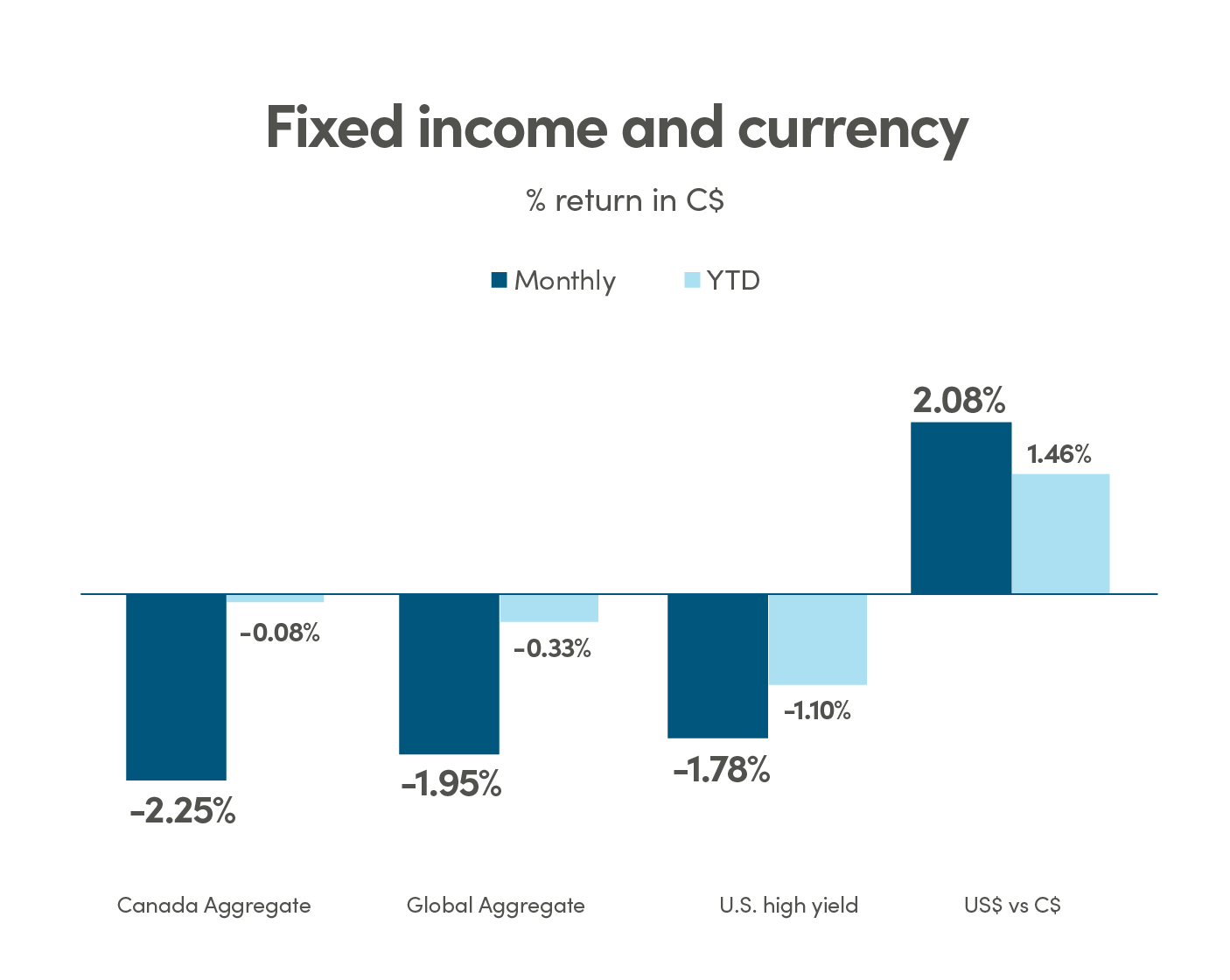
Source: Bloomberg.
Iran conflict: asymmetric impacts across regions
Geopolitical risk centered on Iran travelled quickly through energy and shipping channels. Iran’s restrictions and attacks around the Strait of Hormuz raised the risk premium for global trade, and that matters because the strait has historically handled around 20% of the world’s crude oil flows. Emerging markets can feel the squeeze through, energy shortages, higher import costs and tighter financial conditions when the U.S. dollar strengthens, while Europe, Japan, India, and South Korea are often more vulnerable to energy security when supply routes are threatened. North America is typically more insulated thanks to deeper capital markets and more domestic energy production, but are not immune. Bond yields spiked higher to reflect the inflationary impact of higher oil prices, pressuring equities lower. The net result was a month of regional and sector dispersion rather than a single “global” move.
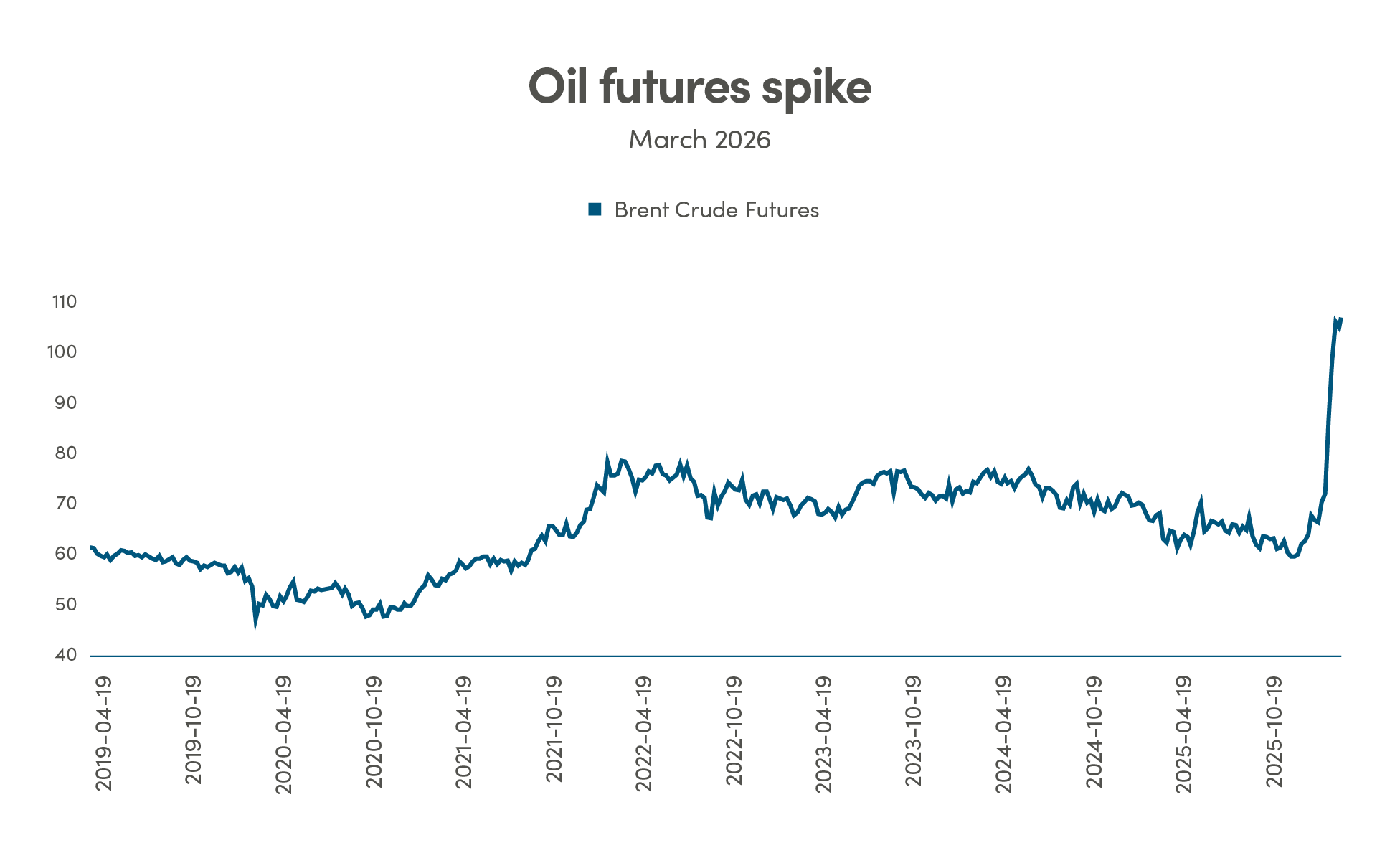
Source: Bloomberg.
Bottom line: March’s market impact was driven by the energy‑and‑shipping transmission mechanism—creating clear differences between oil importers and exporters and widening dispersion across regions.
Canada: resilience from commodities and what gold did (and didn’t) do
Canada’s market structure can provide a buffer during energy‑driven shocks because commodities play a larger role in the make up of the index. At the same time, the month illustrated that “commodities” are not one trade. Gold, typically a safe-haven asset, weakened even as geopolitical headlines intensified. Gold prices fell because of U.S. dollar appreciation, as higher yields are favored over the opportunity cost of holding gold, a non‑yielding asset. This matters in Canada as gold producers can be a meaningful drag in the index when prices of gold bullion declines, while higher energy costs erode the profitability of gold producers. Put differently: oil strength can support one part of the market, while gold weakness can weigh on another, even within the same macro backdrop.
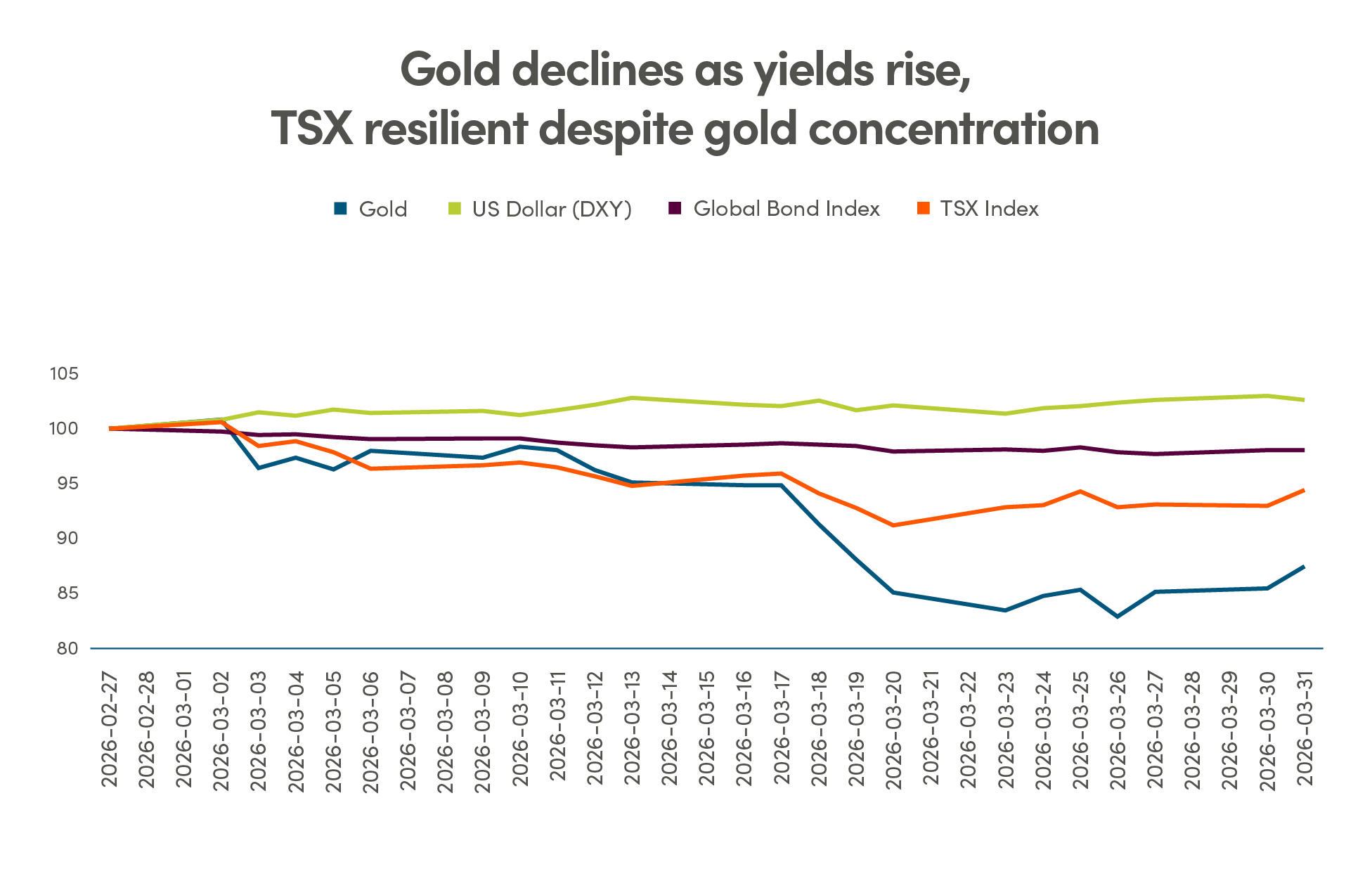
Source: Bloomberg.
Bottom line: Canada’s commodity mix helped at times, but the month also showed that oil and gold can diverge—so “resilience” depended on which commodity exposure dominated day‑to‑day.
Broad equity repricing: volatility rose as investors demanded clarity on earnings and rates
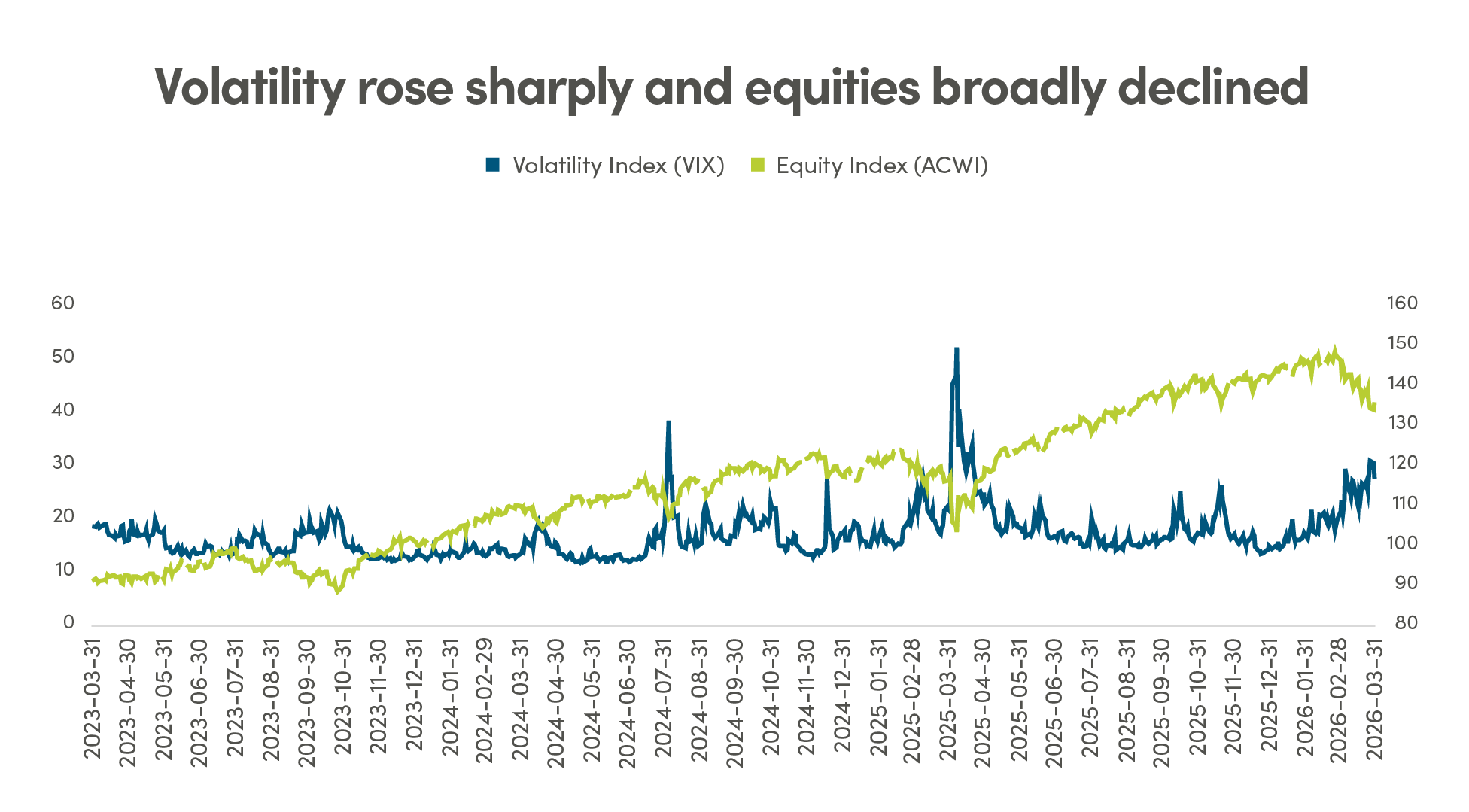
Beyond geopolitics, March appeared like a repricing of uncertainty. Higher energy costs raised inflation concerns while also increasing downside risks to growth—an uncomfortable mix that tends to compress valuation multiples, keep cost of borrowing high, and raise questions on corporate earnings durability. S&P Global’s March outlook captured this trade‑off, noting that the conflict drove it to raise inflation forecasts and lower growth forecasts across many regions, with energy‑import dependent economies more exposed. That backdrop helps explain why equity performance to diverge between businesses with steady and positive cash flow generation versus those relying on lofty growth assumptions. It also helps explain why “safe havens” didn’t behave perfectly: when markets worry about inflation staying sticky, bond yields and the U.S. dollar can rise, which changes the usual playbook. The main story is that markets spent March pricing the second‑order effects: higher rates due to inflation, and slower growth due to supply constraints, rather than trading the headlines alone.
Source: Bloomberg.
Bottom line: Energy shocks put downward pressure on growth and kept inflation persistent, raising the chances of stagflation and a positive correlation between stocks and bonds—where both may lose value. While fleeing risk assets for safety seems appealing, it often harms long-term returns since investors tend to miss recoveries after crises. Remaining invested through volatility is usually wiser to capture long term gains.

Data and opinions as of March 31, 2026.
Aviso Wealth Inc. (“Aviso”) is the parent company of Aviso Financial Inc. (“AFI”) and Northwest & Ethical Investments L.P. (“NEI”). Aviso and Aviso Wealth are registered trademarks owned by Aviso Wealth Inc. NEI Investments is a registered trademark of NEI. Any use by AFI or NEI of an Aviso trade name or trademark is made with the consent and/or license of Aviso Wealth Inc. Aviso is a wholly-owned subsidiary of Aviso Wealth LP, which in turn is owned 50% by Desjardins Financial Holding Inc. and 50% by a limited partnership owned by the five Provincial Credit Union Centrals and The CUMIS Group Limited.
This material is for informational and educational purposes and it is not intended to provide specific advice including, without limitation, investment, financial, tax or similar matters. This document is published by AFI and unless indicated otherwise, all views expressed in this document are those of AFI. The views expressed herein are subject to change without notice as markets change over time. Views expressed regarding a particular industry or market sector should not be considered an indication of trading intent of any funds managed by NEI Investments. Forward-looking statements are not guaranteed of future performance and risks and uncertainties often cause actual results to differ materially from forward-looking information or expectations. Do not place undue reliance on forward-looking information. Mutual funds and other securities are offered through Aviso Financial Inc. Commissions, trailing commissions, management fees and expenses all may be associated with mutual fund investments. Please read the prospectus before investing. Unless otherwise stated, mutual fund securities and cash balances are not insured nor guaranteed, their values change frequently and past performance may not be repeated.
The MSCI information may only be used for your internal use, may not be reproduced or re-disseminated in any form and may not be used as a basis for or a component of any financial instruments or products or indices. None of the MSCI information is intended to constitute investment advice or a recommendation to make (or refrain from making) any kind of investment decision and may not be relied on as such. Historical data and analysis should not be taken as an indication or guarantee of any future performance, analysis, forecast or prediction. The MSCI information is provided on an “as is” basis and the user of this information assumes the entire risk of any use made of this information. MSCI, each of its affiliates and each other person involved in or related to computing, computing or creating any MSCI information (collectively, the “MSCI Parties”) expressly disclaims all warranties (including, without limitation, any warranties of originality, accuracy, completeness, timeliness, non-infringement, merchantability and fitness for a particular purpose) with respect to this information. Without limiting any of the foregoing, in no event shall any MSCI Party have any liability for any direct, indirect, special, incidental, punitive, consequential (including, without limitation, lost profits) or any other damages.
©2026 Morningstar. All Rights Reserved. The information contained herein: (1) is proprietary to Morningstar Research Services LLC, Morningstar, Inc. and/or their content providers; (2) may not be copied or distributed; and (3) is not warranted to be accurate, complete or timely. Neither Morningstar Research Services, Morningstar nor their content providers are responsible for any damages or losses arising from any use of this information. Access to or use of the information contained herein does not establish an advisory or fiduciary relationship with Morningstar Research Services, Morningstar, Inc. or their content providers. Past performance is no guarantee of future results.