

November 2025 Monthly Market Insights
Data and opinions as of October 31, 2025
Rate cuts, earnings, and AI momentum fueled market upside
October’s market gains were driven by a continued surge in AI optimism that lifted mega-cap tech and semiconductors, on the backdrop of the Fed’s easing that fueled risk appetite across equities and long-duration assets, but interrupted by episodic geopolitical trade tensions that injected volatility, prompted safe-haven flows into bonds and gold, and caused sectoral rotations away from trade-sensitive industrials and exporters. Together these dynamics produced strong headline returns offset by sharp intra-month swings, rewarding high-growth, rate-sensitive names while underscoring the value of diversification and tactical hedges. Investors favoured conviction in AI tech leaders while trimmed cyclical exposures.
NEI Perspectives
AI mania and strong Q3 earnings delivery: AI-related stocks, especially in semiconductors and cloud infrastructure, surged as investor enthusiasm continued unabated. Companies with strong AI narratives saw outsized gains, contributing significantly to broader market returns.
Bottom line: Maintain exposure to high- quality AI leaders but should be cautious of pull backs on potential disappointments on growth expectations. Using a barbell strategy—balancing growth with defensive assets—can help manage risk.
Bank of Canada and Federal Reserve rate cuts: The Bank of Canada(BoC), cut rates to 2.25% citing weakening growth driven in part by U.S. trade actions that have dampened exports, investment, and near-term prospects for the Canadian economy. The Federal Reserve (the Fed), also cut rates amid slowing inflation and resilient GDP growth. Lower rates boosted risk appetite, particularly in small caps and speculative tech equity.
Bottom line: Lower rates favor duration-sensitive assets like long-term bonds and growth stocks. Investors might also explore dividend-paying equities as yield alternatives.
Geopolitical trade tensions: Renewed tariff threats on Chinese imports triggered a spike in volatility and stemmed the pullback in gold.
Bottom line: Hedging geopolitical risk through commodities (e.g. gold), and international diversification, especially in markets less exposed to U.S.-China tensions, can provide downside protection.
— NEI Asset Allocation Team

Canada: MSCI Canada Index TR; U.S.: MSCI USA Index TR; International: MSCI EAFE Index TR; Emerging markets: MSCI Emerging Markets Index TR.
Source: Bloomberg.

Canada Aggregate: Bloomberg Barclays Canada Aggregate Bond Index; Global Aggregate: Bloomberg Barclays Global Aggregate Bond Index; U.S. High Yield: Bloomberg Barclays U.S. High Yield Index.
Source: Bloomberg.
AI mania and strong Q3 earnings delivery
Q3 earnings season started with a bang. 63% of companies reported, of which 83%beat expected and reported solid revenue and earnings out performance across most sectors. AI-related stocks, especially in semiconductors and cloud infrastructure, surged as investor enthusiasm continued unabated. Companies with strong AI narratives saw outsized gains, contributing significantly to broader market returns. However, investors are positively cautious, showing growing scrutiny of margins and capital allocation, especially on AI spending. Revenue beats now need to be paired with clear profit paths or efficient AI monetization to sustain rallies. Alphabet delivered a standout AI-driven quarter with record revenue, accelerated cloud backlog, and management framing AI as a clear revenue driver. Amazon’s strong cloud print also helped lift tech and revive confidence, producing notable intraday rebounds. By contrast, other AI-focused names that reported large incremental AI spend without commensurate margin improvement faced more mixed or negative share-price responses, signaling investors’ demand for clearer paths to profitability.
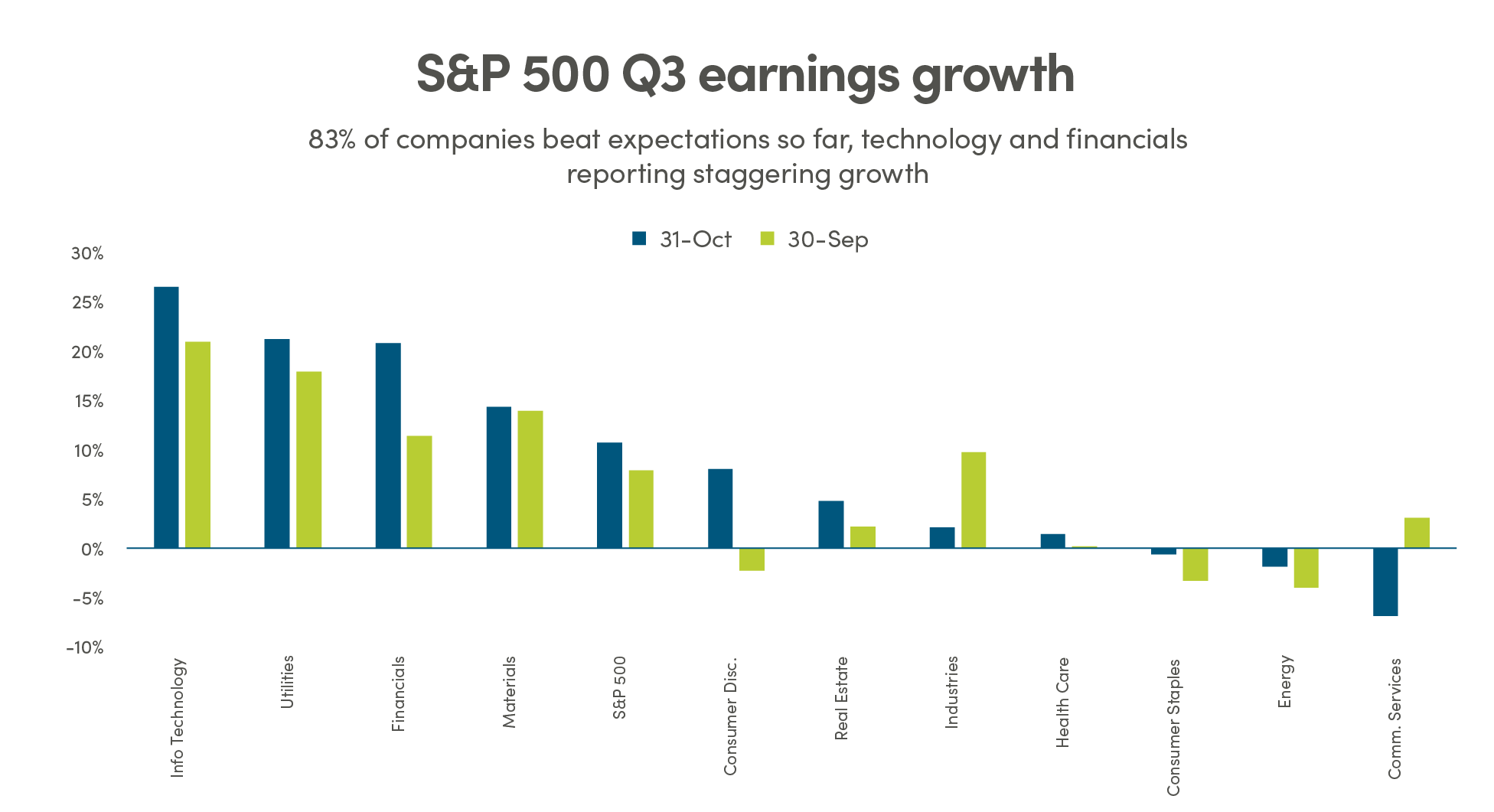
Source: Factset Insight.
Bottom line: Capitalize on this megagrowth trend by favouring large-cap winners with cash-generative cloud businesses and clear margin trajectories. Diversify by keeping liquid exposure to beaten-down cyclicals and smaller cap names with improving fundamentals, using position sizing and hedges (e.g. gold) to protect against headline-driven volatility.
Bank of Canada and Federal Reserve rate cuts
Central banks are splitting paths: the BoC eased by 25 basis points to cushion slowing growth; the Fed also cut by 25 basis points but rates remain higher for longer and remains data-dependent because of a tight labour market and core inflation risks. Rate cuts in North America boosted risk appetite, particularly in small caps and speculative tech equity. In other continents, the Bank of England is holding a restrictive stance while watching persistent wage and services inflation; the European Central Bank is preparing conditional, gradual easing as euro-area inflation and growth diverge across member states; and the Bank of Japan is steady but cautious, keeping rates near current levels while monitoring still-elevated core inflation and domestic demand. These differing stances reflect local inflation, labour, growth, and fiscal positions.
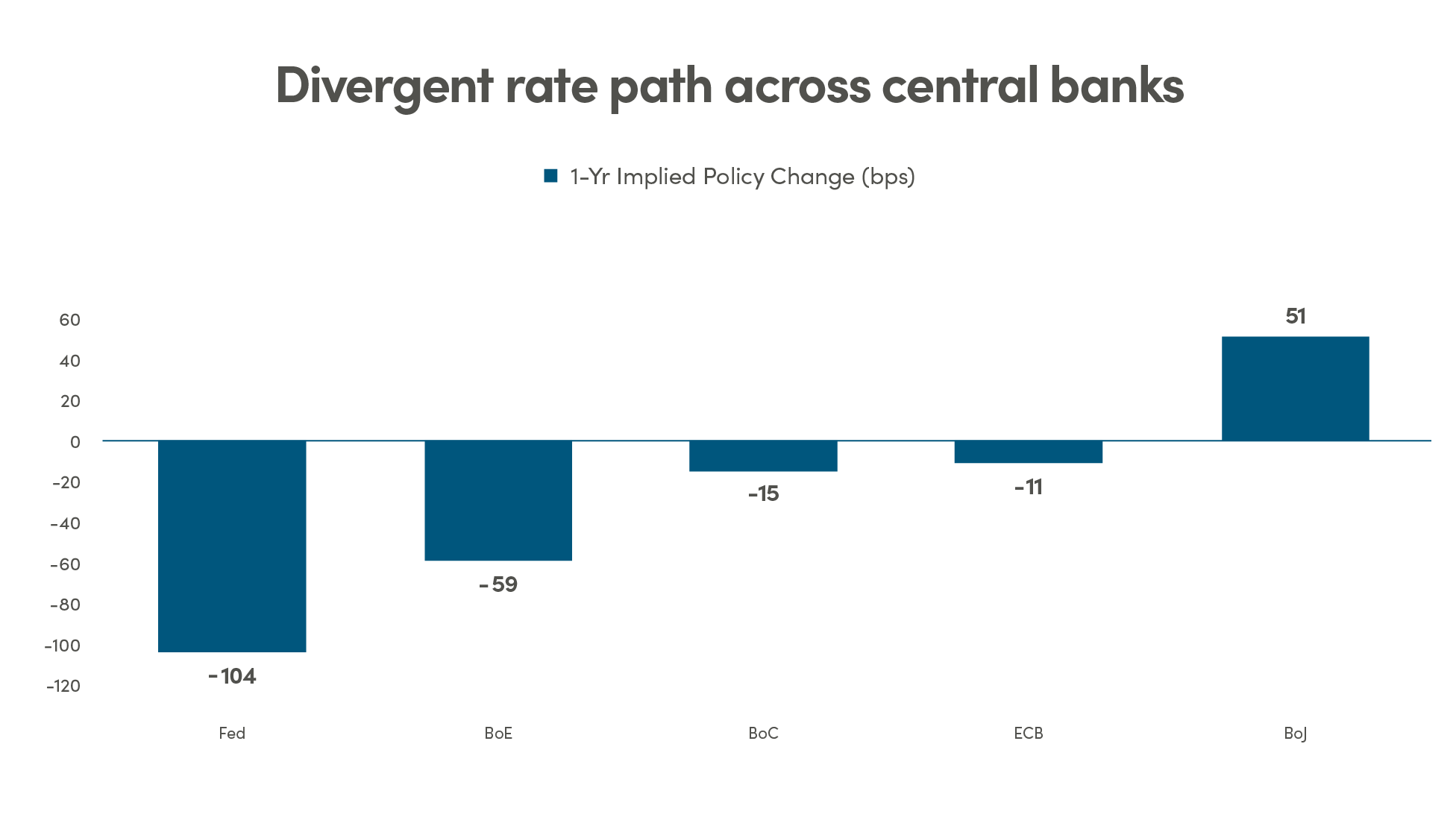
Source: Bloomberg.
Bottom line: These differing rate paths will likely drive volatilities in their currencies. A higher-for-longer Fed keeps support on the dollar through positive rate differentials and safe-haven demand, while lower rates also weaken the loonie and the downside can amplify if growth or commodity exports disappoint. Lower rates favour duration-sensitive assets like long-term bonds and growth stocks. Investors might also explore dividend-paying equities as yield alternatives and increase foreign equity exposures to capitalize on a weaker loonie.
Geopolitical trade tensions
In October, renewed tariff threats from the U.S. on Chinese imports triggered a spike involatility and stemmed the pullback in gold. Meanwhile, Southeast Asian diplomacy and new bilateral U.S. pacts with several ASEAN states signaled a U.S. pivot to diversify supply chains and shore up regional partners. The persistent tariff disputes in Europe and targeted sectoral measures also raised protectionist risks. Markets reacted with brief risk rallies on diplomatic progress, but sustained volatility as investors weighed durable policy change against entrenched strategic decoupling.
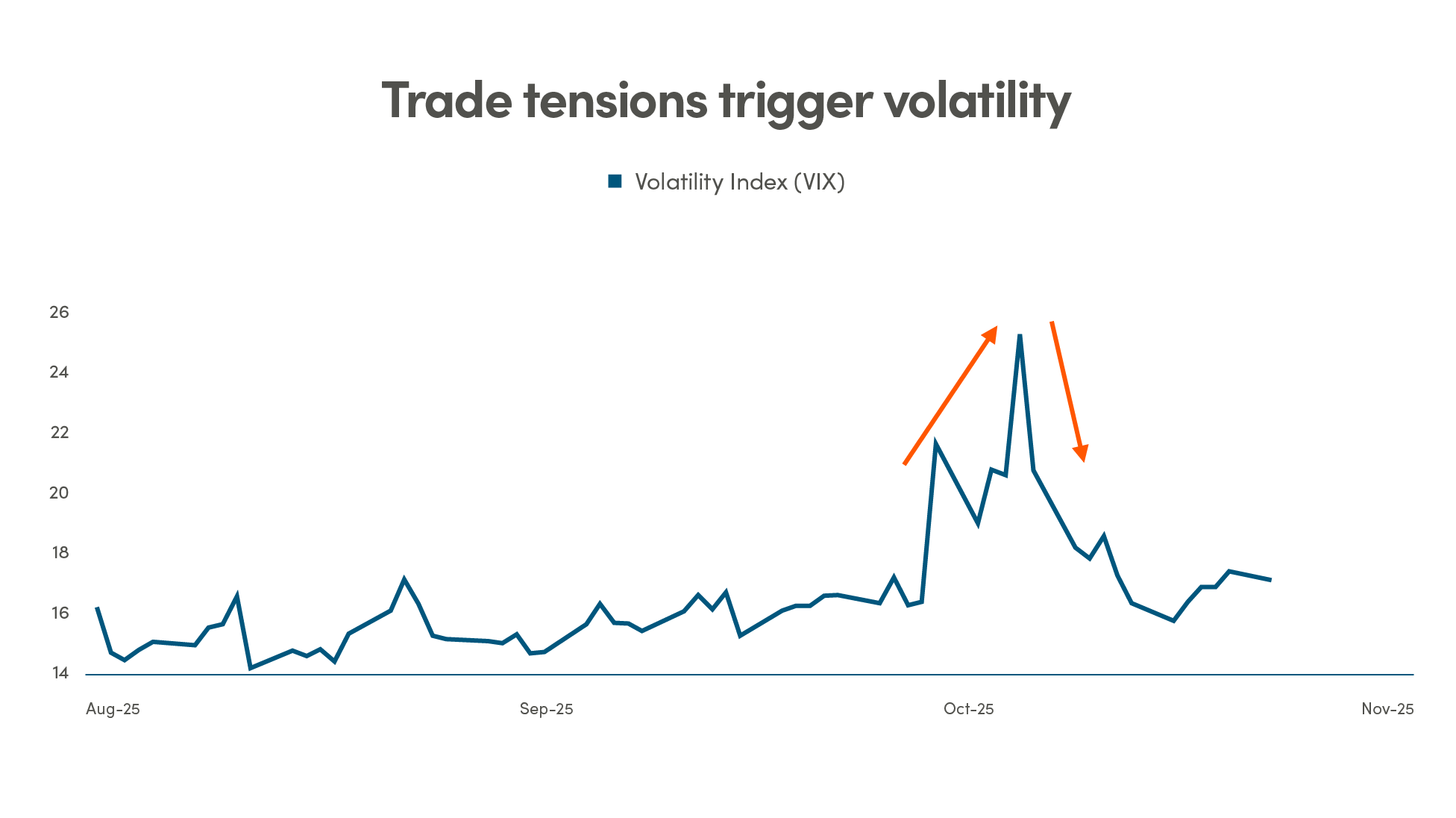
Source: Bloomberg.
Bottom line: Short term geopolitical shocks often increase dispersion between defensive sectors (e.g. utilities, staples, gold)and cyclicals. Investors may hold strategic hedges such as gold, defensive sector exposure, and shorter-duration credit, to reduce portfolio drawdowns from sudden policy shocks. Investors can also keep a small “dry powder” and liquid allocation to buy beaten-down quality names after shock-driven selloffs.

Legal
Aviso Wealth Inc. (“Aviso”) is the parent company of Aviso Financial Inc. (“AFI”) and Northwest & Ethical Investments L.P. (“NEI”). Aviso and Aviso Wealth are registered trademarks owned by Aviso Wealth Inc. NEI Investments is a registered trademark of NEI. Any use by AFI or NEI of an Aviso trade name or trademark is made with the consent and/or license of Aviso Wealth Inc. Aviso is a wholly-owned subsidiary of Aviso Wealth LP, which in turn is owned 50% by Desjardins Financial Holding Inc. and 50% by a limited partnership owned by the five Provincial Credit Union Centrals and The CUMIS Group Limited.
This material is for informational and educational purposes and it is not intended to provide specific advice including, without limitation, investment, financial, tax or similar matters. This document is published by AFI and unless indicated otherwise, all views expressed in this document are those of AFI. The views expressed herein are subject to change without notice as markets change over time. Views expressed regarding a particular industry or market sector should not be considered an indication of trading intent of any funds managed by NEI Investments. Forward-looking statements are not guaranteed of future performance and risks and uncertainties often cause actual results to differ materially from forward-looking information or expectations. Do not place undue reliance on forward-looking information.
Mutual funds and other securities are offered through Aviso Financial Inc. Commissions, trailing commissions, management fees and expenses all may be associated with mutual fund investments. Please read the prospectus before investing. Unless otherwise stated, mutual fund securities and cash balances are not insured nor guaranteed, their values change frequently and past performance may not be repeated.
The MSCI information may only be used for your internal use, may not be reproduced or re-disseminated in any form and may not be used as a basis for or a component of any financial instruments or products or indices. None of the MSCI information is intended to constitute investment advice or a recommendation to make (or refrain from making) any kind of investment decision and may not be relied on as such. Historical data and analysis should not be taken as an indication or guarantee of any future performance, analysis, forecast or prediction. The MSCI information is provided on an “as is” basis and the user of this information assumes the entire risk of any use made of this information. MSCI, each of its affiliates and each other person involved in or related to computing, computing or creating any MCI information (collectively, the “MSCI Parties”) expressly disclaims all warranties (including, without limitation, any warranties of originality, accuracy, completeness, timeliness, non-infringement, merchantability and fitness for a particular purpose) with respect to this information. Without limiting any of the foregoing, in no event shall any MSCI Party have any liability for any direct, indirect, special, incidental, punitive, consequential (including, without limitation, lost profits) or any other damages.
©2025 Morningstar. All Rights Reserved. The information contained herein: (1) is proprietary to Morningstar Research Services LLC, Morningstar, Inc. and/or their content providers; (2) may not be copied or distributed; and (3) is not warranted to be accurate, complete or timely. Neither Morningstar Research Services, Morningstar nor their content providers are responsible for any damages or losses arising from any use of this information. Access to or use of the information contained herein does not establish an advisory or fiduciary relationship with Morningstar Research Services, Morningstar, Inc. or their content providers. Past performance is no guarantee of future results.