

October 2026 Monthly Market Insights
Data and opinions as of September 30, 2026
Higher yields test markets as AI and trade debates intensify
September was a month in which the bond market set the tone. An oil-driven inflation shock prompted the Fed's first rate hike since 2023, while the Bank of Canada held rates steady and long yields kept climbing, even as oil prices eased. Higher borrowing costs raise the bar for the debt-funded AI buildout, which faced its own test as markets swung in response to calls to slow development and governments took early steps toward coordinating AI rules. In Canada, trade escalation and softer labour data weighed on the outlook, while policy-backed investment in AI infrastructure emerged as a meaningful offset.
NEI Perspectives
Higher oil prices pushed rates higher. The Strait of Hormuz disruption kept inflation above target. The Federal Reserve (Fed) raised rates for the first time since 2023, while the Bank of Canada held rates steady and warned that inflation risks had increased. Long-term U.S. Treasury yields reached multi-decade highs. Bottom line: Oil prices eased and core inflation came in softer late in the month, but long yields stayed high. Investors are demanding more to hold long-term bonds, and that dynamic may not fade quickly, even if oil prices do.
The AI debate widened to include who sets the rules. AI stocks fell sharply after several leading AI companies called for the industry to slow down, then recovered to new highs. Meanwhile, the United Nations (UN), the Financial Stability Board, the European Union (EU) and the participants in the U.S.–China summit all addressed how AI should be governed. Bottom line: Global coordination on AI is starting but remains uneven. Regulation is not yet changing AI fundamentals, but headlines about it can move markets sharply.
Canada: tariffs escalated, data softened and AI infrastructure investment accelerated. Matching tariffs took effect, the U.S. added import bans, and August jobs and wage data weakened. At the same time, federal and provincial policies are attracting large-scale AI data-centre investments. Bottom line: Trade uncertainty is weighing on near-term growth, but domestic investment in AI infrastructure is an underappreciated offset.
‒ NEI Asset Allocation team
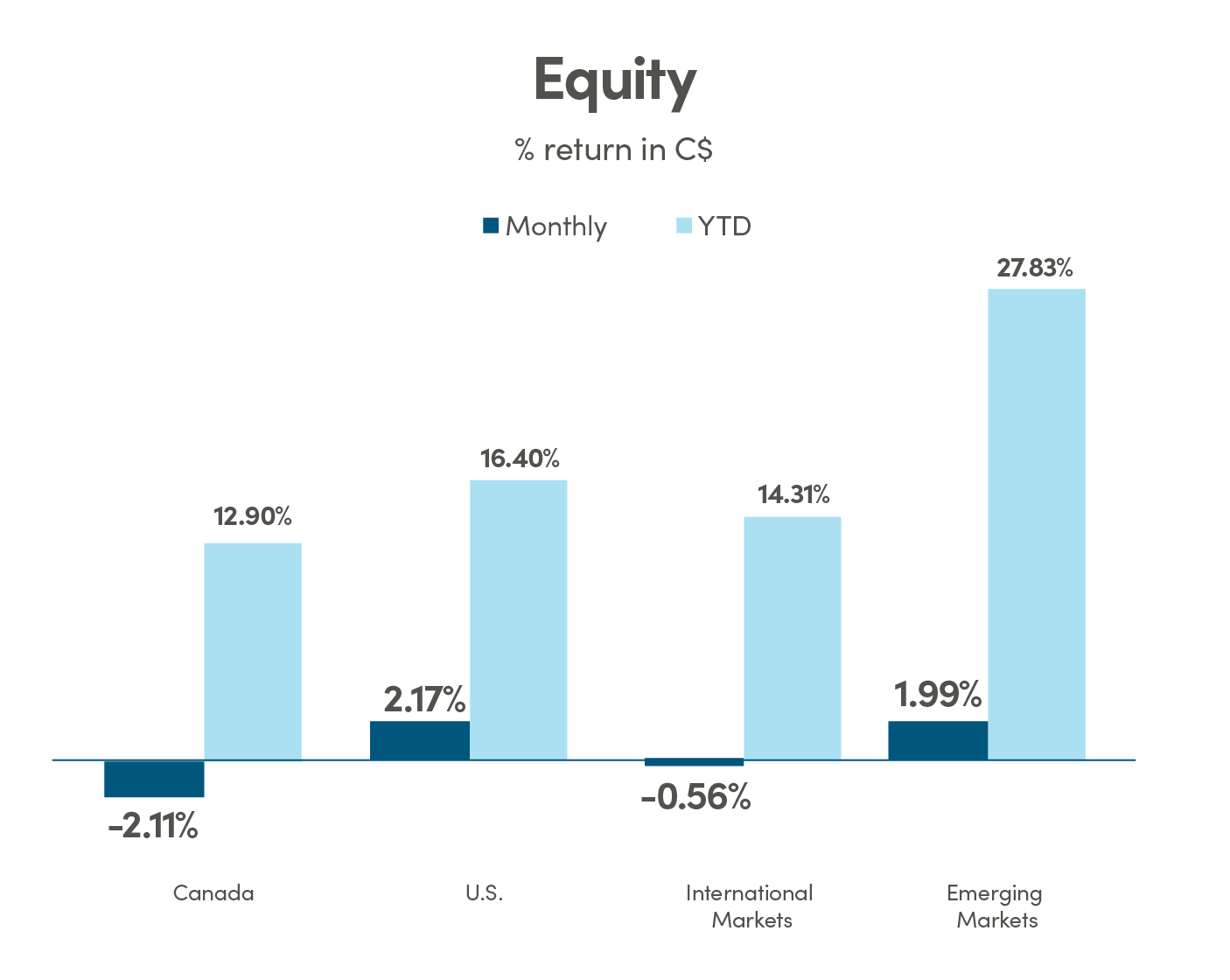
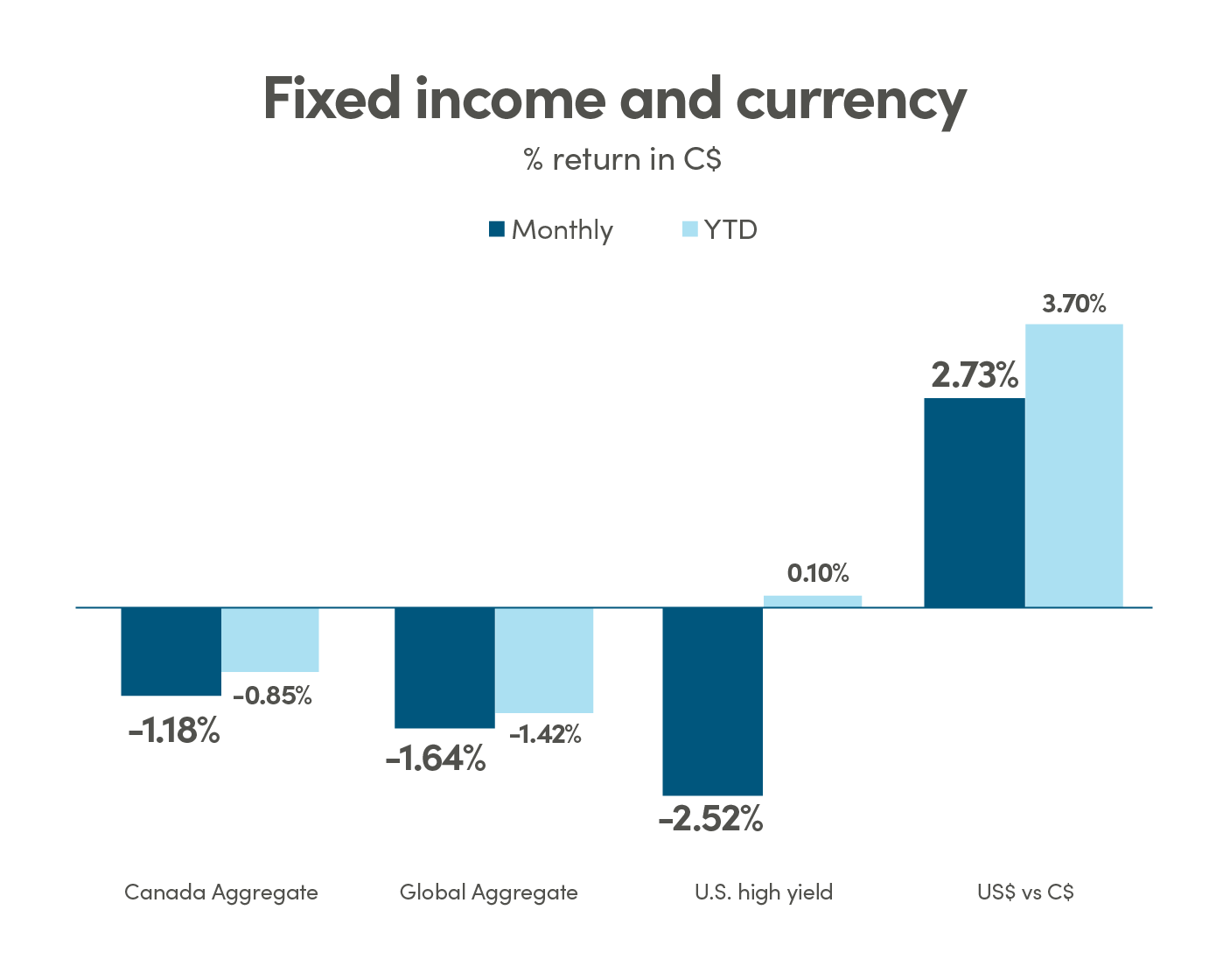
Source: Bloomberg.
Oil pushed central banks apart and lifted long yields
The Strait of Hormuz disruption kept oil near US$100 a barrel and inflation above target. The Fed raised rates by 25 bps to a range of 3.75–4.00% on September 16, its first hike since July 2023, and its median projection now implies one more increase this year. The Bank of Canada held its policy rate at 2.25% for a seventh straight meeting. Canadian headline CPI is near 3%, but excluding gasoline it is 2.2% and core measures are close to 2%, which is close to its target, although the Bank flagged rising upside risks. The policy-rate gap between the two central banks has widened to roughly 150–175 bps.
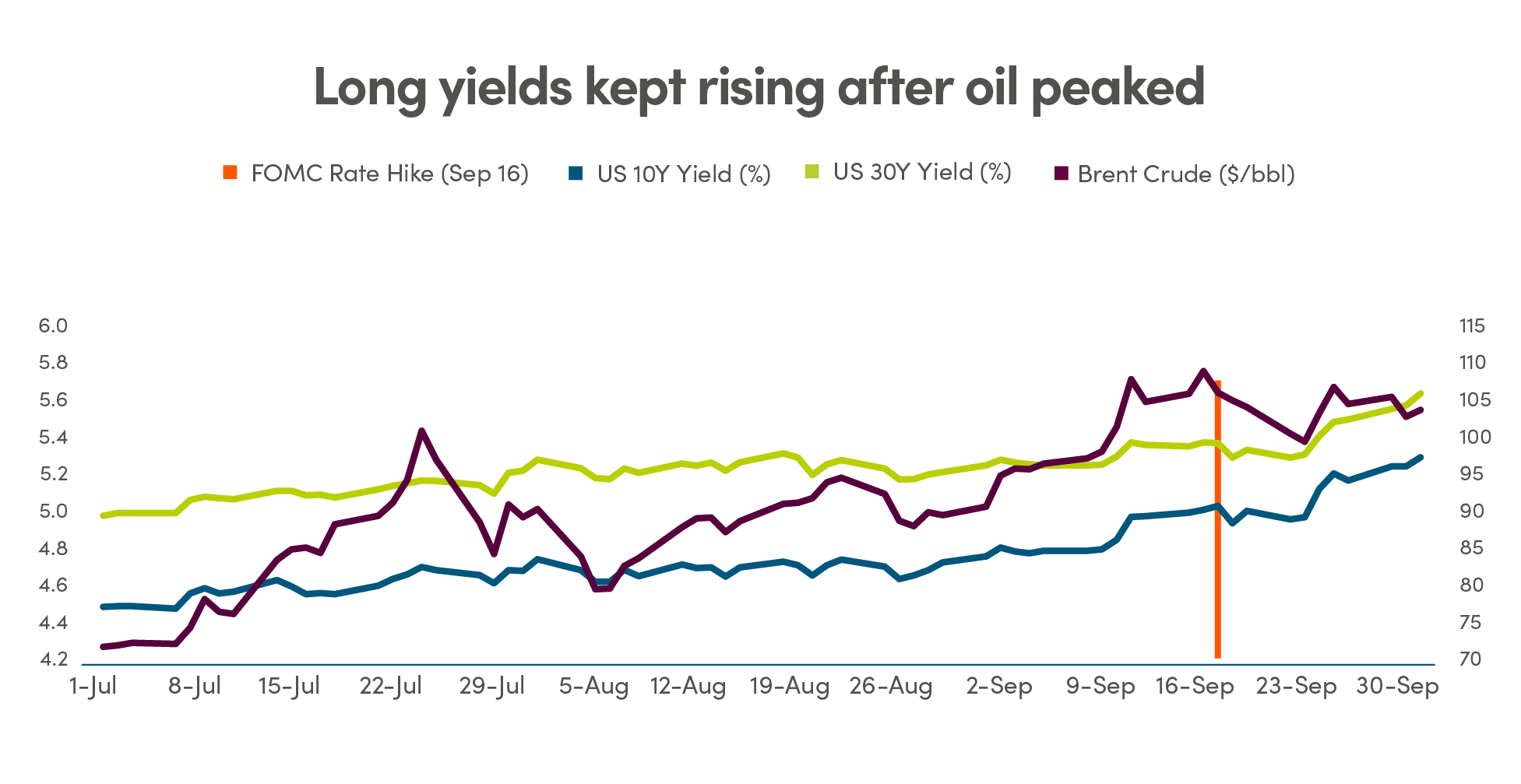
The more telling signal came from the bond market. Late in the month, flows through the Strait of Hormuz reached a six-month high, crude slipped below US$100 and U.S. core PCE inflation came in softer than expected at 3.0%. Long yields rose anyway: the U.S. 10-year ended near 5.30% and the 30-year topped 5.6%, its highest since 2002. Strategists pointed to stronger growth and higher real rates rather than inflation expectations, with heavy government borrowing and AI-related debt issuance adding supply pressure.
Source: Bloomberg. NEI Investments.
Bottom line: Oil started the rise in yields, but strong growth and heavy debt issuance are now keeping them high. Long bond yields may stay volatile even if energy prices keep easing.
AI sentiment swung as governments began coordinating on rules
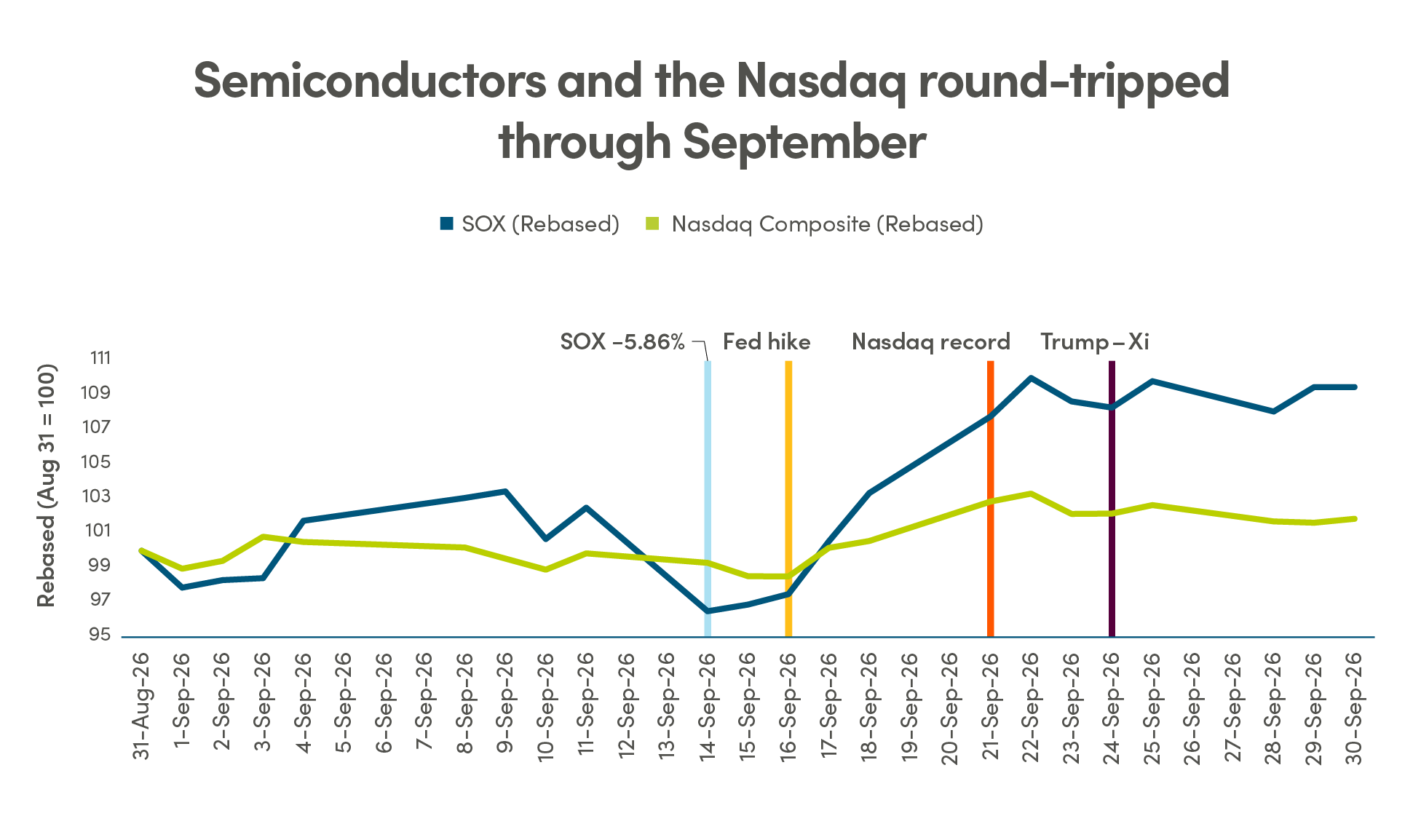
AI stocks went through a full cycle in September. Bubble warnings early in the month gave way to a sharp selloff on September 15, when a call from a leading AI developer to slow frontier AI development pushed the Philadelphia Semiconductor Index down 5.86%. Investors saw the decline as a buying opportunity. Within a week, the Nasdaq was back at a record high, and technology was the only S&P 500 sector to post a gain for the month through September 29.
Source: Bloomberg.
The more durable development was in regulation, where approaches are diverging. Washington dismissed calls to slow down, with the Vice President describing industry requests for regulation as a potential "Trojan horse" for incumbents. Elsewhere, coordination is building: the UN's new Global Dialogue on AI Governance drew 163 countries, the Financial Stability Board told the G20 that cyber risk from frontier AI is the most immediate threat to financial stability, and the EU began enforcing its high-risk AI rules. The Trump–Xi summit added a bilateral channel, with an agreement to begin an AI dialogue within two months and establish a communication channel for AI incidents. Chips and export controls were left off the table, however, and the trade truce was extended by just two months.
Bottom line: Global AI governance is taking shape but remains uneven, with the U.S. firmly opposed to slowing down development. For now, regulation is a risk to sentiment rather than to fundamentals, capable of moving markets sharply without changing the demand outlook.
Canada: trade escalation, softer data and AI infrastructure offset
Trade tensions escalated further. Canada's dollar-for-dollar counter-tariffs on C$27.6 billion worth of U.S. goods took effect on September 8, in response to the 50% U.S. tariff imposed in August. U.S. import bans on Canadian alcohol, dairy products and motorcycles followed on September 29. Ottawa called the bans modest, but the larger risks lie ahead. The U.S. has announced 50% tariffs on autos, parts and steel from January 2027, CUSMA's shift to annual review, and a U.S. administration signalling no urgency to return to talks.
The data are beginning to show the strain. Despite 3.3% GDP growth in the second quarter, Canada lost 42,000 jobs in August, wage growth slowed to 2.0%, and the national benchmark home price fell 3.0% year over year. The S&P/TSX Composite declined about 2.9% in September, pressured more by U.S. yields than by domestic news.
A less visible offset is building. In early September, Ottawa released national principles for data-centre development that require projects to protect electricity ratepayers, limit water use and deliver local benefits. The federal government says it is exploring up to 6 gigawatts of new capacity and more than C$100 billion in potential investment. Announced projects include a 1.2-gigawatt sovereign AI hub in Saskatchewan and a 1-gigawatt facility in Alberta. Canada's clean, reliable power, cool climate and push for data sovereignty make it a natural destination for this buildout.
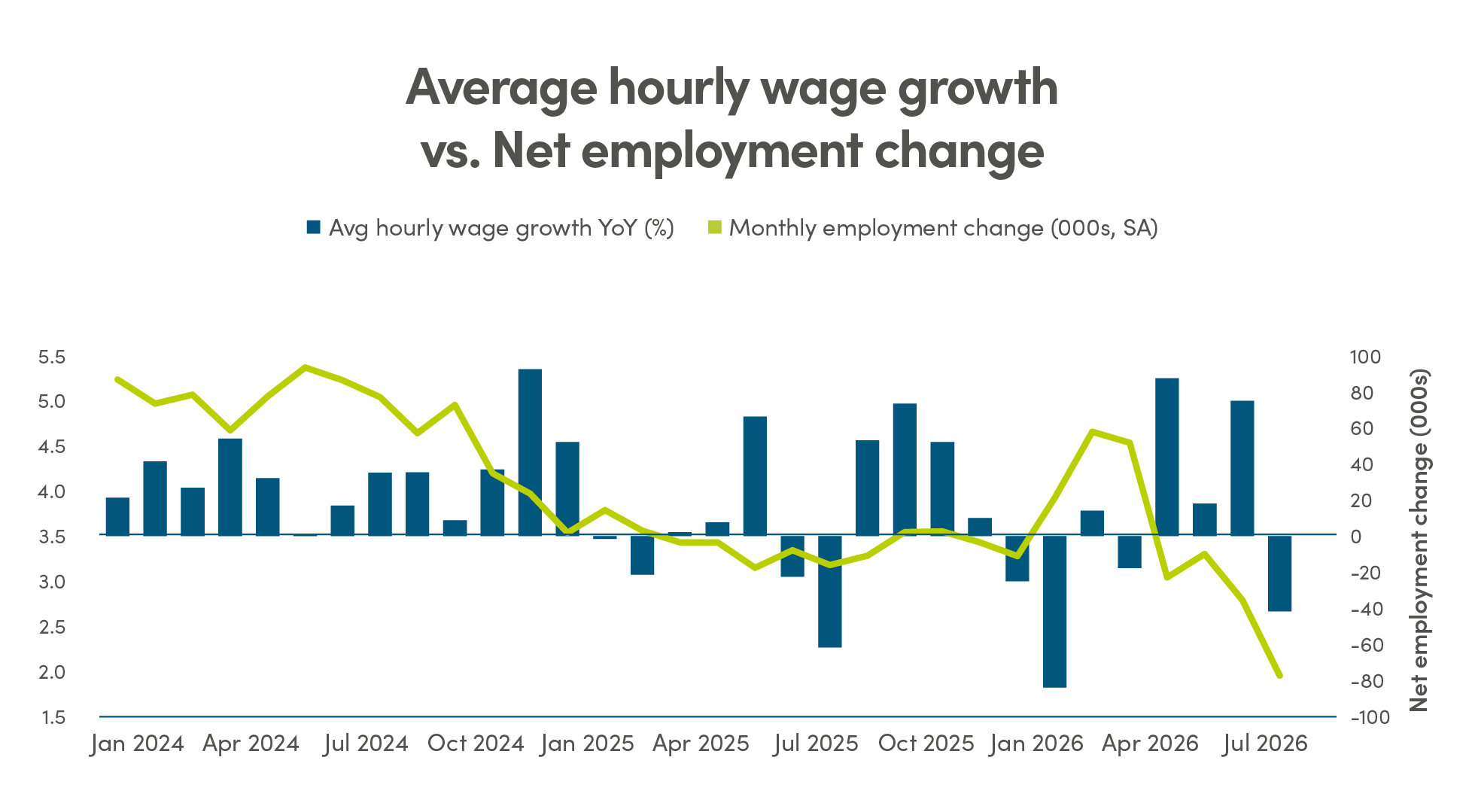
Source: Bloomberg.
Bottom line: Tariffs and trade uncertainty are holding back hiring and business investment. Policy-backed spending on AI infrastructure is a partial offset that few investors are watching closely, linking Canada's energy and construction strengths to the AI buildout.

Data and opinions as of September 30, 2026.
Aviso Wealth Inc. (“Aviso”) is the parent company of Aviso Financial Inc. (“AFI”) and Northwest & Ethical Investments L.P. (“NEI”). Aviso and Aviso Wealth are registered trademarks owned by Aviso Wealth Inc. NEI Investments is a registered trademark of NEI. Any use by AFI or NEI of an Aviso trade name or trademark is made with the consent and/or license of Aviso Wealth Inc. Aviso is a wholly-owned subsidiary of Aviso Wealth LP, which in turn is owned 50% by Desjardins Financial Holding Inc. and 50% by a limited partnership owned by the five Provincial Credit Union Centrals and The CUMIS Group Limited.
This material is for informational and educational purposes and it is not intended to provide specific advice including, without limitation, investment, financial, tax or similar matters. This document is published by AFI and unless indicated otherwise, all views expressed in this document are those of AFI. The views expressed herein are subject to change without notice as markets change over time. Views expressed regarding a particular industry or market sector should not be considered an indication of trading intent of any funds managed by NEI Investments. Forward-looking statements are not guaranteed of future performance and risks and uncertainties often cause actual results to differ materially from forward-looking information or expectations. Do not place undue reliance on forward-looking information. Mutual funds and other securities are offered through Aviso Financial Inc. Commissions, trailing commissions, management fees and expenses all may be associated with mutual fund investments. Please read the prospectus before investing. Unless otherwise stated, mutual fund securities and cash balances are not insured nor guaranteed, their values change frequently and past performance may not be repeated.
The MSCI information may only be used for your internal use, may not be reproduced or re-disseminated in any form and may not be used as a basis for or a component of any financial instruments or products or indices. None of the MSCI information is intended to constitute investment advice or a recommendation to make (or refrain from making) any kind of investment decision and may not be relied on as such. Historical data and analysis should not be taken as an indication or guarantee of any future performance, analysis, forecast or prediction. The MSCI information is provided on an “as is” basis and the user of this information assumes the entire risk of any use made of this information. MSCI, each of its affiliates and each other person involved in or related to computing, computing or creating any MCI information (collectively, the “MSCI Parties”) expressly disclaims all warranties (including, without limitation, any warranties of originality, accuracy, completeness, timeliness, non-infringement, merchantability and fitness for a particular purpose) with respect to this information. Without limiting any of the foregoing, in no event shall any MSCI Party have any liability for any direct, indirect, special, incidental, punitive, consequential (including, without limitation, lost profits) or any other damages.
©2026 Morningstar. All Rights Reserved. The information contained herein: (1) is proprietary to Morningstar Research Services LLC, Morningstar, Inc. and/or their content providers; (2) may not be copied or distributed; and (3) is not warranted to be accurate, complete or timely. Neither Morningstar Research Services, Morningstar nor their content providers are responsible for any damages or losses arising from any use of this information. Access to or use of the information contained herein does not establish an advisory or fiduciary relationship with Morningstar Research Services, Morningstar, Inc. or their content providers. Past performance is no guarantee of future results.